Hi Reader,
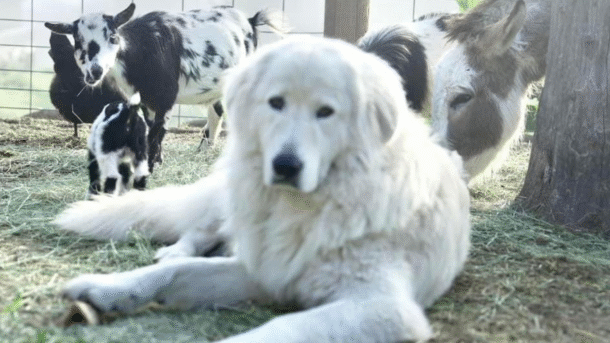
I was outside checking on the newest Maremma puppies yesterday when I saw a text waiting for me on our family group chat. My husband, adult kids, grandkids, and I use it to keep up with each other day to day — usually nothing more dramatic than dinner plans or a funny thing a grandkid said.
Today’s text was: “There’s a mountain lion in Hanford.” 🫣 ⁉️
Hanford is the next town over from me. Fifteen minutes by car. Some of my grown children and their families live there. And someone had posted a Ring camera clip on Facebook — the mountain lion moving through a neighborhood just before 3 a.m., caught on a home security camera. Another photo showed it five or six houses down a street at 5 o’clock in the morning. One gardener even had it jump out of a bush right next to him while he was working in someone’s yard. I’ll be honest, picturing that — a wild mountain lion casually wandering past Ring cameras in a regular neighborhood — felt almost surreal. Except it wasn’t a movie. It was fifteen minutes from my house and literally in three of my grown kids’ backyards. Where my grandkids play, ride bikes and go on walks in their neighborhoods. Scary indeed.
I want to be clear about something: this is not mountain lion country. I’ve heard rumors over the years — someone thought they saw one, someone wasn’t sure — and I always quietly assumed it was a large dog in bad light or an overactive imagination. This time there was photo and video evidence, multiple sighting, and law enforcement eventually got involved. And it all happened in a regular residential neighborhood near the Hanford Sport Complex, not out on the farms at the edge of town. Regular streets. Regular yards. The kind of place where kids ride bikes and people walk their dogs after dinner.
It rattled me. Genuinely. Because here on my farm, my biggest predator concern is coyotes. That’s what I tell people all the time. Coyotes, the occasional fox, nothing that makes the evening news. A mountain lion changes the math entirely — for livestock, for pets, and honestly for people.
Why Are Predators Showing Up in Residential Neighborhoods?
By Wednesday, the Hanford Police Department had received enough reports that they warned residents to avoid the area around Merritt Street and Centennial Drive and brought in the California Department of Fish and Wildlife. (This is near where my grandkids live!) The two agencies worked together, eventually locating the mountain lion resting under a car after a resident called it in. It moved into a nearby bushy area, and wildlife officials were able to safely tranquilize and capture it. Fish and Wildlife is now assessing its health, and if all is well, they plan to release it back into its natural habitat.
What struck me most was the explanation from a Fish and Wildlife representative: the mountain lion likely followed the Kings River corridor down from the foothills east of town, searching for food, water, or other resources, and ended up in Hanford almost by accident. City officials confirmed it’s not entirely unheard of for a mountain lion to wander into town, but it is rare. (I have heard rumors of sighting in the past but never anything official and certainly never anything like this!)
I don’t think this is a total coincidence, and I don’t think it’s only happening here. I’ve been hearing more and more stories lately of serious predators turning up in places that used to be considered safe — regular neighborhoods, small towns, areas nowhere near what anyone would call “wild.” Part of it is what people call urban sprawl: we keep building further and further into what used to be predator territory. Part of it is wildfires and drought pushing animals to relocate in search of resources, the same way this mountain lion apparently followed the river right into a city. Whatever the cause, the result is the same: these animals are ending up closer to where people actually live.
And it’s not always mountain lions. Coyotes are increasingly bold even in well-populated areas. In some parts of the country, wolves are starting to reappear in places they haven’t been for decades. The pattern is consistent — wildlife and people sharing space in ways that used to be rare.
Can a Livestock Guardian Dog Survive a Mountain Lion Encounter?
About a month ago, I had a Maremma Discovery Call with a woman in California — not close to me, but in this state — who survived an actual mountain lion attack. She went outside at night, in the dark, and something hit her hard enough to knock her down. She thought it was one of her own dogs barreling into her. It wasn’t. It was the mountain lion, fresh off a fight with her two dogs.
She broke her ankle in several places. She lost teeth. She had other injuries I won’t try to recall in full, because they were serious. Her heroic dogs — German Shepherds, not livestock guardian dogs — saved her life. One of them died from the encounter. The other was badly hurt but survived. She is lucky to be alive.
She was trying to figure out, in the aftermath, whether Maremmas might be a better option for protection going forward. She has horses and lots of small and beloved livestock she wants to keep safe. But will the LGDs be safe, considering she’s already lost dogs to the cat? It’s a real question, and not an easy one. Puppies wouldn’t be safe in that kind of predator pressure, and adult LGDs would need real time to acclimate alongside her existing dogs.
We didn’t land on an answer in that call. But one thing I did tell her: livestock guardian dogs are built around ritualized aggression — barking, posturing, and presence, designed to scare a predator off rather than engage it in a fight to the death. That’s a fundamentally different strategy than GSDs, who are bred for bite work and whose instinct is to go straight for the attack. I can’t promise a different outcome. But the nature of how these dogs are wired to respond to threats is genuinely different, and that difference can matter.

Do You Need a Maremma Sheepdog If You Don’t Have Livestock?
Here’s where my thinking has shifted. I used to think of Maremmas as something for farms. Stock. Acreage. That was my whole world for many years. Then I started realizing that these dogs can make wonderful companions in the right home. But I still saw these as two different roles for the same dog – protection against predators OR pet. But maybe the lines are a lot more blurred than even I thought.
Lately, I keep hearing the same story in different forms. I was contacted by a nun living in a residential area, with mountain lions showing up in broad daylight near her home, worried for her Collies. A woman with an elderly Chihuahua, already planning her next small dog, is asking whether a Maremma could help keep her little ones safe in the yard and on walks. And then there’s Tom, down in Southern California — a regular neighborhood, nothing rural about it — whose Prancing Pony Maremma, Jimmy, stepped directly between a coyote and his Golden Retriever, Gidget, on a walk last week. Jimmy wasn’t guarding sheep. He was guarding his family. That’s what these dogs do — they protect whatever they’ve bonded to.
I see people put spiked collars and protective vests on their small dogs to try to deter coyotes and other predators, and I understand the instinct. But honestly, I don’t think those things do much. A predator going in for a kill isn’t pausing to assess risk to itself. It’s not thinking about a few plastic spikes. It’s going for it. A small dog wearing one of those collars is still a small dog facing a much bigger problem. I see those getups as not much better than Halloween costumes. If it makes you feel you’ve done something to protect your little dog, go for it. As for me, my little dogs have their own bodyguard – a Maremma named Titus.
Is a Maremma Sheepdog a Good Fit for a Non-Farm Home?
It can be — but it’s worth thinking through honestly. These are big, vocal dogs, and how much they bark depends heavily on what’s around to bark at. If you live somewhere with a strict HOA or close neighbors who won’t tolerate a dog speaking up at a real or perceived threat, that’s a genuine consideration. You also need to actually want a big, independent dog as part of your family, not as a hired bodyguard you can ignore the rest of the time. The guard what they bond with – any living thing, including humans.
If you’re a dog person who already loves big dogs, or you’ve been wanting one anyway, it might be worth asking whether that dog could also be the line of defense for the people, pets, and property you care about most. (And honestly I can’t think of anything more valuable for one of my dogs to protect than someone’s children.)
What Should You Do If Predators Are Showing Up Near You?
The Hanford mountain lion has a peaceful ending — captured safely, assessed for health, and likely to be released back into the wild where it belongs. I’m genuinely glad it ended that way, for the cat and for the neighborhood. But the fact that it happened at all, fifteen minutes from my home, in a town where some of my own grandchildren live, has stuck with me. It’s gotten me thinking hard about how many people outside the farming world are quietly dealing with this same fear — for their kids, their pets, themselves — without realizing there’s an option built specifically for this kind of protection.
If this is something you’ve been thinking about, even loosely, I’d genuinely love to talk it through with you.
→ Book a Free Discovery Call
Stay safe out there,
Kim
Wondering what’s currently available? |