I had a whole different email scheduled for this week. Then this happened, and I couldn’t not tell you about it.
The Backstory: A Van, a Mess, and a $2,200 Decision
A little backstory first, because it matters for how this whole thing unfolded.
I’ve been hauling my Maremmas to the vet loose in the back of my minivan for years — folding the seats down and letting whoever needed to go just ride back there. It works, but it also means every trip leaves my van covered in mud, hair, and whatever else a livestock guardian dog picks up on a farm. 🫣 My husband recently got it detailed for me, and I knew the very next trip would trash it all over again.
So I went down the rabbit hole of dog transport crates. I looked at Impact Crates like the one my son uses for his police dog (never even got a reply from their dealer program, so that was out). I considered a big wire crate, but I couldn’t get past the safety risk of putting my dogs into something that flimsy. I finally landed on a heavy-duty van crate from a company called TransK9 USA — built to fit my Honda Odyssey exactly. It wasn’t cheap. Between the crate and shipping, I was a little over $2,200 in. But I knew it was an investment in my dogs’ safety, so it was worth it.
It sat in my driveway in the box for a few weeks before I got it installed. (It weighs about 75 lbs!) Once it was in, I was genuinely excited — I pictured taking my Maremma puppies on their first car rides, snapping cute photos, and sharing it with all of you.
The first passenger in that crate was not a puppy. It was a goat with a broken leg. I’ll get there.
Why One of My Maremmas Wouldn’t Come When I Called
A few days before any of this, I’d rearranged some of my dogs — something I do often, since figuring out which dogs live well together is a constant puzzle. I’d moved Circe into a pasture with two of our horses and a couple other Maremmas.
For two or three nights in a row when I went out to feed, Circe wouldn’t come to me. She’d hang back near the calf hutches my goats use for shelter, and no amount of calling would budge her. I chalked it up to Cameo, one of the dogs she was with, being a little possesive around food, and figured Circe just didn’t want to get on Cameo’s grumpy side. I made sure she had her own food elsewhere and didn’t think much more of it.
The third night, it was late and I was tired, and I almost just fed everyone and went back inside. But Circe wasn’t just hanging back this time — she was inside the calf hutch and wouldn’t come out at all. That was different enough that I walked out into the dark pasture to check on her.
What a Maremma Sheepdog’s Guarding Instinct Actually Looks Like
The second I got close, Circe came out. She had a bite wound on her leg from some kind of scuffle (probably with Cameo), nothing serious. But behind her, inside that calf hutch, was a goat who had no business being in that pasture at all.
It turned out Marigold had jumped a short fence a few days earlier while she was out grazing weeds in the barnyard, almost certainly trying to reach the dogs’ food. Goats do that sometimes. She must have broken her leg on the jump and then done what injured goats instinctively do: gone somewhere to hide.
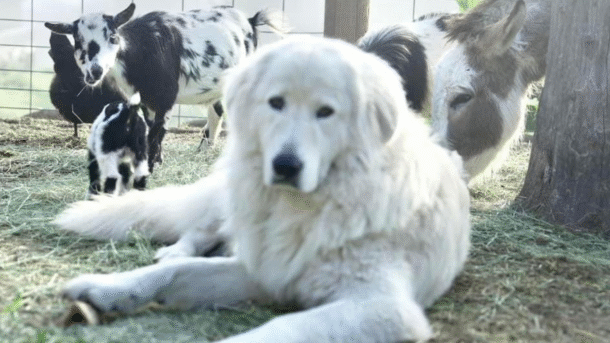
Circe had found her. And for at least two or three days, she stayed close enough to guard her, refusing to leave even to come eat, even when I called. She wasn’t being stubborn. She was doing exactly the job her breed was built for, and she was trying to tell me something was wrong the whole time. I just hadn’t been paying close enough attention to notice.
Noah, Rowan, and Ren with Marigold, back from the vet
Getting Marigold Fixed Up
I moved them both to the puppy parlor, tended Circe’s wound, and texted my vet first thing the next morning. She’s about a minute from my house and has regular Wednesday surgery hours, so she squeezed Marigold in as a walk-in.
My son Noah was hosting two friends visiting from England (he met them online, which seems to be a running theme with how my kids meet their friends and even 3 of their spouses). Rowan and Ren had come out to the farm to see the animals, and ended up helping with barn chores and deworming and vaccinating Nova’s 12-week-old pups who are almost ready to head to new homes. When it was time to load Marigold, Noah just picked her up — she’s a solid 120+ pounds — and set her in that brand-new fancy dog crate. (I love having a strong farm kid for these jobs.)
So much for puppy glamour shots. A goat with a major injury was the very first to ride in that expensive crate I bought for dogs. But the van stayed clean!
The break wasn’t as bad as one I dealt with a couple of years ago with a doe named Hela, so a splint did the job. Hela had a splint and a cast, and it took a couple of hours to get it set.) $618 later, Marigold is back home, splinted up and resting near Circe and the three litters of Maremma puppies in the puppy parlor, both of them recovering side by side. (My Puppy Parlor doubles as a hospital ward.)
Why the Mischievous Puppy Often Becomes the Best Livestock Guardian Dog
Here’s what I want you to understand about what Circe did, because it matters more than the story itself.
Circe didn’t just happen to be a good livestock guardian dog because she’s a Maremma Sheepdog. It was her LEGS – Learning, Environment, Genetics, Self. Her breed gave her the raw material, but genetics alone don’t build a dog who guards an injured goat for three days straight. That takes a foundation laid from the time she was a puppy: proper socialization with livestock during the critical socialization period, and then the same consistent, careful training and management continued throughout her adolescence. She was never just turned loose with animals and left to figure it out. She was acclimated, supervised, and set up to succeed, every step of the way.
And here’s the part I really want you to sit with: Circe was not an easy adolescent.
When she went through her teenage phase, she was mischievous. Never mean, never aggressive, but definitely rowdy. She’d chase animals she shouldn’t chase. She pushed boundaries the way most young livestock guardian dogs do at that age. I know a lot of you have a dog going through that exact phase right now, and I know how frustrating it feels. It makes you question everything: the dog, the breeder, whether you made a mistake, whether you’re cut out for this at all.
I didn’t give up on her. I knew her genetics were right. I knew she’d been socialized properly as a puppy. I knew I was doing the same things with her that I do with every dog here. So I stayed patient, kept managing her environment so she couldn’t practice the wrong behaviors, and waited for her to mature.
That’s the job, by the way. You can’t teach a dog to guard livestock the way you’d teach sit or polite leash walking. What you can do is set up the environment so the dog only gets to practice the right things, and give them time to grow into the amazing LGD they were meant to be.
Circe’s Transition From Rowdy Teenager to Devoted Protector
This isn’t even the first time Circe has stuck by a goat in need. When she was not quite two years old, right at the edge of that adolescent phase, one of my does had triplets unexpectedly (a pregnancy I hadn’t even caught). The mama goat abandoned the babies. Circe found them and refused to leave them, guarding all three until we got the mother back and reunited them. That was the first time I really saw her maturity click into place. Looking back, it makes total sense that she did the same thing for Marigold. She’d already proven she had it in her.
Circe matured into exactly the dog I knew she’d be. I’ve noticed the same mischievous streak shows up in some of her puppies, too. It doesn’t worry me. If anything, it’s often a preview of a young dog who’s going to mature into a remarkable adult LGD.
There were three well-bred, livestock-savvy dogs in that pasture with Marigold. All three could have done what Circe did. But Circe, the one who gave me the most trouble as a young dog, was the one who stayed. She didn’t give up on Marigold, because I didn’t give up on her when she needed me to be patient.
If you’ve got a young livestock guardian dog pushing your buttons right now, this is your reminder: don’t panic, don’t give up, and don’t skip the supervision and management it takes to get them there. You might be raising your own Circe.
For a limited time, come talk Maremmas with other Maremma owners and me — free. Have a different livestock guardian dog breed? You're welcome here too — most of what we cover applies to all LGDs.
These calls and their recordings will become part of the Maremmas Made Easy membership community soon, so signing up now gets you a free sneak peek at the membership, plus first access to founding-member pricing when it launches.
You're in! Check your inbox for your Zoom link.
2 Comments
Molly
on August 27, 2026 at 7:48 pm
Artemis was exactly like this as an adolescent dog. She chased, pushed boundaries and if you left any personal item in the barn or pasture she would pick it up and run away with it. We kept working with her and she is now the most solid, reliable dog. We never have to worry about her, she seems to be able to handle any situation.
That’s so interesting that she was such a handful as a pup. She was the tiniest little puppy in the litter. I guess she wanted to make sure the world knew she shouldn’t be underestimated! 😆
Her dad used to LOVE stealing things and hiding them in his sleeping spot: toys, gloves, sticks, sunglasses, etc. Once, he stole an entire saddle pad as my daughter was saddling her horse and stepped away for a few minutes!
Artemis is further proof that rowdy puppies do grow up, eventually!
For a limited time, come talk Maremmas with other Maremma owners and me — free. Have a different livestock guardian dog breed? You're welcome here too — most of what we cover applies to all LGDs.
These calls and their recordings will become part of the Maremmas Made Easy membership community soon, so signing up now gets you a free sneak peek at the membership, plus first access to founding-member pricing when it launches.




Artemis was exactly like this as an adolescent dog. She chased, pushed boundaries and if you left any personal item in the barn or pasture she would pick it up and run away with it. We kept working with her and she is now the most solid, reliable dog. We never have to worry about her, she seems to be able to handle any situation.
That’s so interesting that she was such a handful as a pup. She was the tiniest little puppy in the litter. I guess she wanted to make sure the world knew she shouldn’t be underestimated! 😆
Her dad used to LOVE stealing things and hiding them in his sleeping spot: toys, gloves, sticks, sunglasses, etc. Once, he stole an entire saddle pad as my daughter was saddling her horse and stepped away for a few minutes!
Artemis is further proof that rowdy puppies do grow up, eventually!