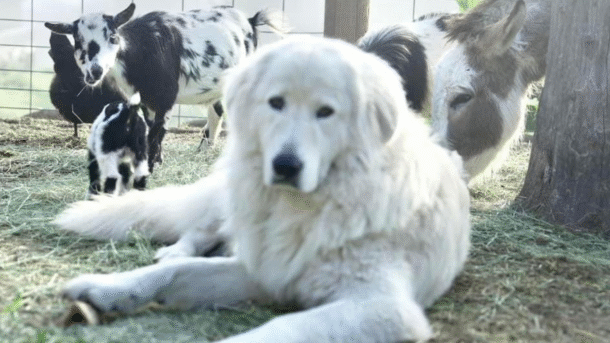
This week’s Maremmas Made Easy call turned into a masterclass on barking, and I barely had to say a word. (Okay, I said a few.)
Two of my puppy families joined us. Sara’s Millie is seven months old and just hit 70 pounds. She showed up fresh from a swim in the creek, followed by a dip in the pool. 🐾 Cynthia’s boys, Arthur and Merlin, are four and a half now, and her stories had all of us leaning in toward our screens.
We also welcomed Becky, whose 9-month-old Maremma Cash is learning the ropes, and Denise, who has a Great Pyrenees and is thinking about her next livestock guardian dog. Great questions from everyone.
Do Maremma Sheepdogs Bark at Nothing?
Denise’s neighbor insists her Great Pyrenees barks at “nothing” at night. Cynthia, who lives up in the hills with mountain lions, bears, coyotes and foxes, had a lot to say about that.
Her boys barked a fair amount when they were young, but they were quick to learn what’s a threat and what isn’t. Now they ignore the deer that wander by. Arthur shrugs off a skunk in his pasture at feeding time. Merlin once escorted a skunk the whole length of the pasture from about 20 feet back, and didn’t bark until it went through the gate.
Coyotes, foxes, mountain lions, bears, and strangers down on the road? Those get barked at. Cynthia used to run out with a big flashlight and see nothing. Then the next day she’d hear from neighbors a quarter mile away about a mountain lion on their trampoline or a bear in their trash.
Sara said the same about Millie: she only barks when something is actually there.
From my perspective, Maremmas bark when there’s something appropriate to bark at, so how much depends on your predator load. And a single livestock guardian dog will often bark more than dogs working as a team.
Quick takeaway: Just because you can’t see it doesn’t mean it isn’t there. Your dog is reading the night with her nose and ears long before your eyes catch up.
Arthur and Merlin know what to bark at
What Can You Do When Neighbors Complain About Your LGD Barking?
Denise isn’t alone. One of my clients has had complaint letters and even sheriff visits over her young dogs. One of these same dogs recently fought off a mountain lion that jumped into her pasture and saved her goats. (Story coming soon.) These dogs know what they’re doing!
My advice to my client and Denise: contact the Farm-to-Consumer Legal Defense Fund. They have a department just for livestock guardian dogs, and they’ll explain your local laws and right-to-farm protections. You don’t need a big commercial operation to qualify, either. My client assumed her little hobby farm with a few goats and chickens didn’t count, and that wasn’t true.
Cynthia’s tip: before her boys went to work, she told her neighbors to expect barking at night. (One neighbor said, “Great, maybe they’ll keep them out of my place too!”)
Quick takeaway: Talk to your neighbors early. If it escalates, call the experts. (I’m not a lawyer, but they are!)
Is It OK to Call Your LGD Back When He’s Chasing a Predator?
Becky asked this one. A mangy fox has been taunting Cash at the edge of their property, and she wondered if calling him back would break his instinct to protect.
Short answer: you’re not going to ruin him. Most dogs have physical fences that stop them from finishing a chase, so how is that really different from her calling him back? Constantly telling a dog not to do what his instinct says would be a different story.
Cynthia added that these dogs are so smart, if you go out, tell them “good job,” and then call them back, a few repetitions is all it takes for them to figure out: I bark, I tell it to get out of here, and then I can come back. Becky was already doing it. She’d shine a light where Cash was barking, and he’d settle.
Quick takeaway: Acknowledge the work, then recall. You’re telling him “I see it, thank you,” not “stop guarding.” (That being said, if your dog keeps barking it’s likely for a good reason. Trust your dog.)
Should You Get a Puppy for Your Older LGD to Raise?
Denise’s Pyr is seven, and she’s thinking of bringing in a puppy for her to raise. I don’t recommend getting a pup for an older dog to raise. I recommend getting two pups.
Puppies and adult dogs have very different developmental needs. A lot of older dogs don’t want to be babysitters. Some are aggressive to puppies, and others just won’t play the way a puppy needs.
Someone had also told Denise never to get two LGDs because they’ll fight. That’s the “littermate syndrome” myth and there’s no such thing. It comes down to individual dogs and matching them well. And sometimes managing them, as well.
Cynthia’s boys are a great example. Around 18 months, Arthur started redirecting frustration onto Merlin when he couldn’t get at something on the other side of the fence. This isn’t Littermate syndrome. It’s barrier frustration, and very common with dogs. So she gave each boy his own pen and his own animals, about 50 yards apart. They still back each other up, and to a predator it sounds like a whole pack. They often curl up side by side with the fence between them. Even Cynthia admits that the boys would probably do great being on duty together now, but since she needs them covering different territory and animals this arrangement is what works for everyone.
Her biggest tip: spend one-on-one time with each dog. When a wildfire forced an evacuation last year, both boys loaded straight into trailers with their animals, something they’d never done before, because Mom said it was ok.
Quick takeaway: Two puppies close in age, plus individual time with each one, gives you bonded, confident guardians. Here’s more on why two LGDs are better than one.
When Should You Add a Second Livestock Guardian Dog?
Sara stayed after to ask this. Millie was meant to be a companion for her little boy, but she’s turned into a real guardian. The other evening she chased off what the camera later showed was four coyotes, at 7:30 at night.
My answer: now, if you’re considering it. Sara’s planning to get chickens in the spring, right on the coyote highway, and one young dog can’t handle bold predators that come as a pack. You risk losing animals, and you risk an injured dog and a big vet bill. And ultimately her son is at risk because predators that bold aren’t above attacking a child. I suggested she get a puppy close to Millie’s age, and since she’s a girl, her next puppy should be a boy.
Sara noticed that when she walks toward Millie during a standoff with the coyotes, Millie pushes even farther out. That’s Millie trying to keep her safe. When my dogs start barking, my goats run behind them and let the dogs handle the threat. They don’t follow the dogs toward the threat. Millie is telling her to stay back and let her work!
Sara is also worried about her 13-year-old Lab, who likes Millie but gets a little weary of her puppy antics sometimes. I told her a second puppy would actually help him. The puppies would play with each other, and he gets to supervise instead of being a bored single puppy’s favorite target.
Quick takeaway: Add the second dog before you add the livestock. (And yes, that goes for companion Maremmas with predators around, too.)
Millie proves that a companion Maremma is still a guardian
LGDs spend a lot of time outside and get into more mishaps than the average pet dog. One of my puppy families had several thousands in vet bills after freak injury and some chewed-out stitches. I once walked into my pasture to find one of my own girls had degloved her thigh, probably snagged it on the corner of a fence panel. That was a $2,500 bill. My boxer, Luna, almost died a few years ago when she swallowed a squeaker out of a dog toy. That was a $3600 bill. Pet insurance can’t prevent issues like these but it can help reduce the financial strain that comes with them.
I advise my clients to keep insurance on their puppies for at least the first year or two, then decide if you want to continue. Trupanion pays the vet directly but costs more. A lot of people have been really happy with Figo, which you can get through Costco.
Quick takeaway: Even with health testing and ethically bred puppies, there’s never a guarantee that you won’t ever incur unexpected vet bills. Insurance buys you peace of mind.
After two years of mostly girls, I finally have boys! I have some sweet, adorable four-month-old males right now. The parents of my youngest litter are on the smaller side for Maremmas, so those pups probably won’t be giants. Perfect for smaller properties or people who just prefer a smaller dog. Fill out my applicationif you’re interested in one of these great pups.
Denise asked why my puppies don’t go home until 12 weeks at the earliest. I’ve tried different ages over the years. Holding them a little longer means they’re properly socialized, have had most of their vaccines and are hardier for travel, and their new families (most of whom are first time Maremma owners) aren’t overwhelmed. It’s what helps my puppies, and their people, succeed.
I’m also trying something new this week. I PennHIP test puppies regularly as part of my breeding program, and for the first time I’m offering one of those tested puppies for sale. Marisa’s Pink Girl is available now.
PennHIP is an x-ray evaluation that measures how loose a puppy’s hips are, starting at 16 weeks old, and predicts their risk of developing hip arthritis later in life. Pink Girl’s hip score is 0.34 L & 0.40 R, which PennHIP rates as mild risk, and her report shows no signs of arthritis.
Why is she available? She met the standard for a healthy, sound working dog or companion, but not my standard for my breeding program, so she’s ready for her family.
A couple of honest notes. A good PennHIP score lowers the odds of a puppy developing hip problems, but no test can completely rule them out, since hip-dysplasia is a multi-factored disease, shaped by complex genetics as well as environmental factors.
Every one of my puppies comes from health-tested parents and gets the same health guarantee and lifetime support, tested or not. A younger puppy at the standard price is still the standard in ethical breeding and a smart, sound choice. But for those that want extra reassurance a tested puppy could be a great option and extra peace of mind.
PennHIP-evaluated puppies are their age price plus $500, which covers some of the cost of testing. (My vet charges $500-600 for a puppy this age.) Pink Girl’s price goes up by $250 when she turns six months old in mid-November. (All of our puppies increase in price at 6 months, so if you’re thinking about a puppy now is the time to act and save $250.)
This is a pilot, so tested puppies will be occasional for now. If there’s enough interest, I may offer more. And if you’d like hip information on a different puppy, any puppy 16 weeks or older can be PennHIP tested through my vet at your cost. Just ask.
Interested?See Pink Girl’s listing or hit reply and tell me whether PennHIP-evaluated puppies are something you’d want. Your replies help me decide whether to offer more.
Whether you’re looking for a working livestock guardian dog or a companion, I’d love to help you find the right fit. See available puppies or hit reply and tell me about your place and your goals.
Where Can You Get Maremma Sheepdog Answers Every Week?
As Sara said at the end of the call, the best part is hearing everyone’s stories. Every owner brings a different experience and perspective, and someone else’s question often answers the one you were about to ask.
These calls are free for now. The Maremmas Made Easy membership is coming soon, and the weekly calls will move inside it. Register once and come to any session. The link is in the box below.
Talk to you soon,
Kim
P.S. Cynthia took Arthur in for his annual checkup the day of the call, and the vet staff said, once again, they couldn’t believe how comfortable he is with them. Her answer: “What did Kim do with them when they were puppies?” Mine: I had my grandkids play with them. Best job in the family. 😊
Every Tuesday at 5pm Pacific, I host a free Maremmas Made Easy Q&A call on Zoom. Whether you’re researching the breed, waiting on a puppy, or already living with a Maremma, you’re welcome. Register once and come any week.
For a limited time, come talk Maremmas with other Maremma owners and me — free. Have a different livestock guardian dog breed? You're welcome here too — most of what we cover applies to all LGDs.
These calls and their recordings will become part of the Maremmas Made Easy membership community soon, so signing up now gets you a free sneak peek at the membership, plus first access to founding-member pricing when it launches.
For a limited time, come talk Maremmas with other Maremma owners and me — free. Have a different livestock guardian dog breed? You're welcome here too — most of what we cover applies to all LGDs.
These calls and their recordings will become part of the Maremmas Made Easy membership community soon, so signing up now gets you a free sneak peek at the membership, plus first access to founding-member pricing when it launches.