What happens at your place when it’s feeding time? Does your dog eat calmly and relaxed — or is there tension in the air? Maybe a goat keeps nosing toward the bowl. Maybe your other dog hovers a little too close. Maybe your LGD eats faster than seems necessary, or stiffens when another animal gets within a certain distance. Maybe things escalate even further, with growls and snaps and flying fur.
If any of that sounds familiar, I want you to know: that’s resource guarding. And it’s one of the most important things to pay attention to in a Livestock Guardian Dog.
Here’s the thing people get wrong about resource guarding: it’s not bad behavior.
It’s not dominance. It’s not your dog being “difficult.” Resource guarding is a completely normal canine behavior — and in Maremma Sheepdogs and other LGDs, it’s practically baked into their DNA. We bred these dogs to protect what they value. The problem is when that instinct gets pointed in the wrong direction.
And the most dangerous direction? At your livestock.
I’ve seen it happen. A dog who was allowed to feel anxious and threatened at mealtimes — because the goats kept stealing their food, because feeding time was chaotic, because no one ever made them feel safe while they ate — started generalizing that threat response to the livestock themselves. That is one of the leading causes of LGD rehoming and euthanasia, and it is almost entirely preventable.
The fix for resource guarding isn’t complicated, but it does require intention.
Feed your LGDs separately from the livestock. Always. Be present at mealtimes. Never let livestock anywhere near your LGD’s food bowl. And if you have multiple dogs and notice tension between them at feeding time — growling, stiffening, one dog hovering over another’s bowl — take that seriously too. Dog-to-dog resource guarding around food is extremely common in LGDs and just as important to manage.
If your dog is already showing tension around food — stiff body, hard eyes, growling at another dog or at livestock that get too close — don’t punish the warning. Listen to it.
I’ve written a full post on this topic that covers everything: what resource guarding actually is, how to recognize early warning signs, practical management strategies, and specific training techniques that can change your dog’s emotional response around resources.
If you’re dealing with this right now and need help, my training consultation line is always open.
For Prancing Pony Farm families this is included in the price of your puppy. If you have an LGD from another source, I offer paid training consultations. You don’t have to figure this out alone.
Have an LGD from another source — but struggling with a behavior or training challenge?
Oh, and one more thing — if you’ve been thinking about adding a Maremma to your farm, now is a great time to get on the list.
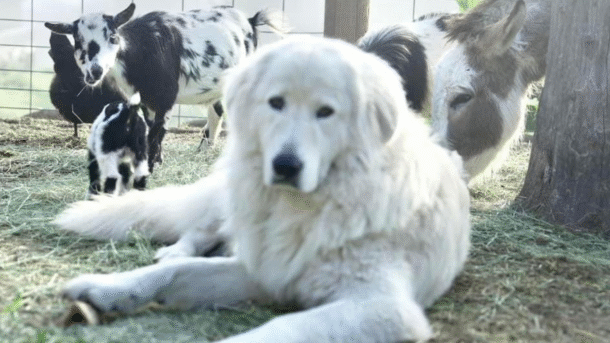
Nova and her pups are enjoying the cooler nights out with the goats
Every Prancing Pony Farm puppy goes home with a solid foundation and a lifetime of breeder support included. These dogs are set up for success from day one.
P.S. The number one rule I want you to walk away with: never punish a growl. A dog that growls is talking to you. A dog that’s been punished for growling learns to skip the warning — and goes straight to the bite. Always address the cause, not the communication.
For a limited time, come talk Maremmas with other Maremma owners and me — free. Have a different livestock guardian dog breed? You're welcome here too — most of what we cover applies to all LGDs.
These calls and their recordings will become part of the Maremmas Made Easy membership community soon, so signing up now gets you a free sneak peek at the membership, plus first access to founding-member pricing when it launches.
For a limited time, come talk Maremmas with other Maremma owners and me — free. Have a different livestock guardian dog breed? You're welcome here too — most of what we cover applies to all LGDs.
These calls and their recordings will become part of the Maremmas Made Easy membership community soon, so signing up now gets you a free sneak peek at the membership, plus first access to founding-member pricing when it launches.