Last Updated on June 7, 2026 by Kim Crawmer, KPA CTP, LFDM
The Mentor Dog Who Shapes Every Puppy’s Journey
At our farm, there's a dog whose contribution to my breeding program is so valuable that I consider her role second only to the mother dogs themselves.
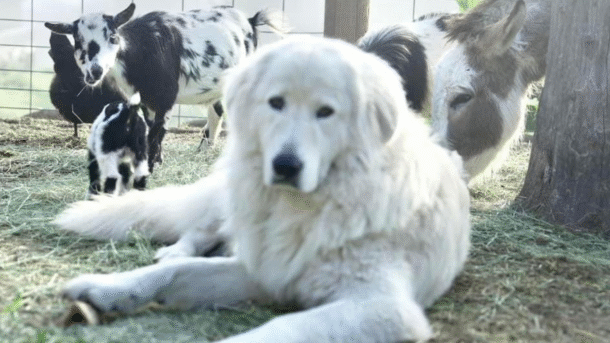
Meet Genevieve—or as we call her, "Auntie Genny."
At 9 years old, this wise and affectionate 9-year-old Maremma Sheepdog has spent nearly a decade perfecting the art of livestock guardian dog socialization. She's raised four litters of her own (one of her daughters, Polar, is one of my best livestock guardians). But her greatest gift to my program isn't her own puppies—it's what she teaches every single litter that comes through our farm.
Through patience, gentle guidance, and flawless example, she transforms curious young pups into calm, confident, and capable working dogs. Genevieve is more than a farm favorite—she’s the cornerstone of my puppy mentoring program, and her influence touches every livestock guardian dog we raise.

The Discovery of a Natural Mentor
When Genevieve joined our farm at ten months old, I had no idea she’d become the foundation of my livestock guardian dog training program...
She was my second Maremma ever and my first breeding female—I was still learning what exceptional looked like.
But Genevieve showed me.
As an excellent mother to her own puppies, she demonstrated patience and gentleness that stood out even among good mothers. But what really caught my attention was how she responded to other puppies—not just her own.
Every time I brought home a young dog from another breeder to add to my program, Genevieve immediately adopted them. I have pictures of her with nearly every dog I've purchased as a puppy, including Simba (one of my current stud dogs) who was just 9 weeks old when he arrived and desperately needed that maternal presence.
She simply loves puppies. Not all dogs do.

What Makes Genevieve an Exceptional Livestock Guardian Mentor
The Temperament That Can't Be Trained
Genevieve possesses a rare combination of traits that make her irreplaceable:
- Genuine Love for Puppies: She actively seeks out puppy interaction and clearly enjoys their company—even the chaos and energy that comes with young dogs.
- Unlimited Patience: Puppies can climb on her, pull her tail, pester her endlessly, and she never reacts with anything but tolerance. If she gets annoyed, she simply walks away—no corrections, no aggression, just gentle redirection.
- Perfect Livestock Guardian Dog Example: As an excellent working livestock guardian herself, she models ideal behavior with all livestock species. Puppies learn by watching her calm confidence and gentle, protective behavior with livestock.
- Universal Respect: Most of my mother dogs know and trust Genevieve, readily accepting her help with their litters. This allows for seamless integration when puppies need additional mentoring.
- The Energy Manager: At 9 years old and spayed after her fourth litter, Genevieve has discovered the perfect role—she can conserve her energy while still feeling needed and purposeful.

The “Go Check That Out” Story – A Lesson in Confidence and Calm
My favorite Genevieve story perfectly captures her personality and intelligence.
When she was younger, she worked alongside Olaf, my first Maremma and her longtime mate and companion. Anytime there was unusual activity at the fence line or some distant noise requiring investigation, Genevieve had a consistent response: she would bark at Olaf as if to say, "Go check that out, will ya?"
And he would go. Olaf would dutifully trot off to investigate while Genevieve waited patiently. When he returned, there would be this moment of exchange between them—he'd look at her, she'd assess whatever he communicated, and then she'd calmly return to her business.
Genevieve has always known how to spare her energy and delegate the hard parts. Now in her semi-retirement as full-time puppy mentor, she's applying that same wisdom—focusing her considerable experience exactly where it matters most.

How a Mentor Good Dog Supports Livestock Guardian Puppy Socialization
The Integration Timeline
Genevieve’s mentoring begins during a critical window of livestock guardian puppy socialization, when young dogs are forming lifelong impressions about livestock, adult dogs, and humans. I typically introduce Genevieve to a litter between 4-5 weeks, depending on the mother dog's temperament and readiness to share puppy duty.
Some mothers welcome the help immediately: By 4-5 weeks, puppies are mobile, energetic, and demanding constant attention. These mothers are delighted when Genevieve arrives to share the load. The puppies can snuggle with "Auntie Genny," play under her supervision, and give their mothers a much-needed break.
Other mothers need more time: If a mother dog is particularly protective or uncertain about sharing, I wait until she's naturally ready to wean—usually around 6-7 weeks. I begin by giving the puppies time with Genny while their mom takes a break. Eventually, Genevieve seamlessly takes over the mentoring role while the mother gradually steps back.
The beauty of Genevieve's presence is that she gives mother dogs permission to rest while ensuring puppies still receive constant supervision and guidance.

What Puppies Learn from Genevieve
Livestock Guardian Excellence:
- Calm, confident presence around all livestock species
- Appropriate protective positioning between livestock and potential threats
- Gentle interaction with stock
- When to be alert vs. when to relax
- How to read livestock signals and respond appropriately
Social Skills:
- Respectful interaction with adult dogs
- Understanding social hierarchy without fear
- Appropriate play boundaries
- When persistence is acceptable vs. when to back off
- How to exist peacefully in a multi-dog environment
Emotional Regulation:
- Patience with challenging situations
- Calm responses to excitement or stress
- Gentle rather than aggressive communication
- Confidence through steady example
- How to be both powerful and kind
Physical Confidence:
- Using their bodies appropriately around livestock
- Safe navigation of varied terrain and environments
- Comfort with close physical contact and handling
- Recovery from minor bumps and corrections

Mentoring vs. Bullying – Why Positive Modeling Matters
Many LGD breeders misunderstand the difference between mentoring and correction. At Prancing Pony Farm, we rely on positive, gentle modeling rather than dominance or punishment-based training.
This is where Genevieve's approach differs dramatically from what some breeders allow or even encourage.
Many people believe adult dogs "train" puppies through corrections, dominance displays, and physical discipline. I've purchased dogs raised this way, and they were always problematic—either excessively fearful or carrying a defensive "chip on their shoulder," ready to attack first and ask questions later.
These dogs learned that the world is threatening and that aggression is the appropriate response.
Genevieve teaches the opposite: The world is safe, livestock are family, humans are trustworthy, and there's no need for defensive aggression when you're truly confident.
She never corrects puppies aggressively. She models, redirects, and occasionally removes herself if puppies become too much. Her teaching method is entirely positive—showing rather than punishing, guiding rather than forcing.
This creates puppies who are confident rather than defensive, protective rather than aggressive, and deeply bonded to livestock rather than suspicious of them.

The Perfect Semi-Retirement – Wisdom in Action
In her semi-retirement, Genevieve’s mentoring role keeps her engaged and valued while continuing her lifelong work as a calm livestock guardian presence.
At 9 years old, Genevieve has earned her easier pace. But retirement doesn't mean uselessness—it means wisdom applied where it matters most.
Her current role provides everything an aging working dog needs:
- Purpose and Value: Training puppies is arguably the most important job on the farm after birthing them. Genevieve knows she's essential.
- Comfort and Care: The climate-controlled Puppy Parlor gives her a comfortable place to rest during extreme weather while staying close to her charges.
- Physical Activity: Puppy play keeps her moving and engaged without the constant patrol demands of full-time guardian work.
- Social Connection: Constant puppy companionship means she's never alone, always needed, always loved.
- Continued Livestock Guardian Work: The livestock are right there in the puppy pasture. She's still protecting, just with help and at her own pace.
- This isn't just kindness to a retired dog—it's strategic. Genevieve's experience and steady presence create better puppies than I could produce without her. She's irreplaceable.

Why Mentor Dogs Create Better Livestock Guardians
Puppies who learn from calm, confident adult dogs like Genevieve develop better self-regulation, stronger livestock bonds, and fewer behavioral issues. They grow into balanced protectors who understand both boundaries and kindness.
When you receive a puppy from Prancing Pony Farm, you're receiving a dog who learned from Genevieve.
That means your livestock guardian dog arrives with:
- Weeks of observation and copying from a perfect example
- Positive associations with livestock of all types
- Confidence built through patient, gentle guidance
- Understanding of appropriate behavior learned from watching excellence
- No trauma, no defensive aggression, no fear-based responses
Genevieve's influence shapes every puppy's foundation—and that foundation lasts a lifetime.

Questions to Ask Other LGD Breeders
When evaluating LGD breeders, ask about their LGD puppy mentoring program:
- Do you use adult dogs to help train puppies?
- Which dogs do you choose for this role and why?
- How do your mentor dogs interact with puppies?
- Do you allow adult dogs to correct puppies? How?
- Can you show me photos and videos of adult dogs with puppies?
- What's your philosophy on puppy mentoring?
Red flags:
- "Adult dogs teach puppies respect through dominance"
- Allowing aggressive corrections or bullying
- Using any adult dog without evaluation
- No specific mentoring program or philosophy
- Defensive responses about adult dog behavior with puppies

The Legacy Continues
Genevieve’s daughter, Polar, now carries her legacy forward—proof that both genetics and example (nature and nurture) matter when raising exceptional livestock guardian dogs.
The patient, confident, livestock-focused approach runs in the bloodlines, but more importantly, it's taught by example in every litter.
As Genevieve ages gracefully into her mentor role, she's created a standard for what adult dog guidance should look like in my program. Future dogs will be evaluated against her example—not just for their working ability, but for their capacity to teach the next generation with the same patience and love she's demonstrated for nearly a decade.
Because exceptional livestock guardians aren't just born—they're taught by dogs like Auntie Genny.

Frequently Asked Questions About Livestock Guardian Dog Mentoring
What is a mentor dog in a livestock guardian program?
A mentor dog is an experienced adult LGD who models calm, confident behavior for puppies. They guide socialization and help young dogs learn proper behavior with livestock and humans.
Why is puppy socialization important for livestock guardian dogs?
Early socialization builds emotional stability, livestock trust, and confidence. It prevents fear-based reactions and creates balanced working dogs.
Can any adult LGD mentor puppies?
Not every adult dog has the right temperament. Mentor dogs like Genevieve are selected for gentleness, steadiness, and positive influence on young pups.

Ready to reserve a puppy trained by the best? Apply for our waiting list
Questions about our mentoring program? Schedule a Maremma discovery call to learn more