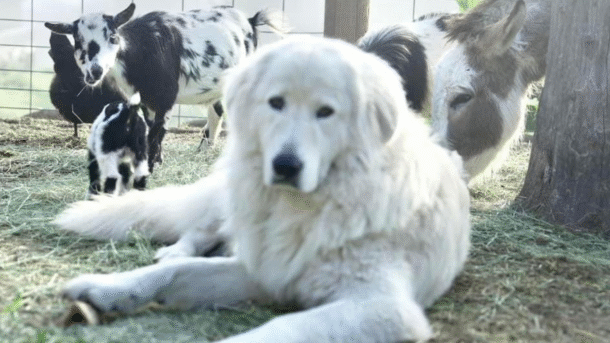
I had plans. The bucks had different plans. And so here we are — six surprise kids born in February, all healthy, all adorable, and all very much in need of homes that are not my farm.
It happens. You do this long enough, and you learn that “the plan” is more of a suggestion than a guarantee when it comes to farms and live animals. Oh well, a few baby goats (as opposed to the 100+ we’ve had for multiple years) are always fun and great for training young LGDs.
2026 Baby Goat Kids
The 2026 “oops” babies are available now.
We have a mix of doelings and bucklings/wethers — two (mostly Nigerian Dwarf) Mini Nubian doelings and four bucklings/wethers. (In case you didn’t know, Mini Nubians are a cross between Nigerians and Nubians, so technically these are Mini Nubian kids, but most of them look more like Nigerians with slightly longer ears.
All are being sold unregistered (we don’t know who the sires are, since the bucks were less than discriminating about who they visited). All priced at $400. All ready to go between now and mid-May.
Photos and details are on my goat website — I’ve listed each one individually so you can see exactly what’s available and when they’ll be ready.
If you’ve been thinking about adding dairy goats this spring, this is your window. These kids are the only ones we will have this year, and I don’t expect them to last long once people start looking.
A weekend worth telling you about.
This past weekend was the kind of weekend that reminds me why I do all of this.
Four of my granddaughters came for a sleepover on Saturday. These are my middle daughter’s girls (I have 6 kids and 16 grandkids – so far) — they visit often and they know their way around this farm. They know how to handle goats and horses, how to behave around tiny pups and giant LGDs, and exactly how fast the golf carts will go if you let them.
And yes, we let them.
The golf carts are technically farm equipment. We use them to haul feed, feed animals, move supplies. But when the girls are here, they become their personal vehicles and they make full use of the property — giggling, racing (loosely supervised), jumping on the trampoline by the puppy parlor, generally being exactly as loud and chaotic as a group of girls on a farm should be.
Here’s what I love about that from a dog perspective: all of that noise and energy and motion is doing socialization work even when the girls aren’t directly interacting with the dogs. The puppies hear the carts, the laughter, the trampoline. They see movement and activity and unpredictable kid energy — and they learn that all of it is just normal life. That’s exactly what you want in well-socialized Maremmas.
When they weren’t tearing around the property, the girls were doing the real work — socializing the puppies. We have pups at a few different ages right now and the girls spent time with all of them: the little five-week-olds who are just starting to really engage with the world, the eight-week-olds who are at the prime age for socialization, and the older pups who are already well-socialized, more confident and ready to romp.
Getting puppies comfortable with children — their movements, their sounds, the way they handle dogs — is not something you can skip. It matters enormously for how these dogs settle into family life and for ensuring they grow up to be safe, friendly dogs who handle farm visiotors and whatever life throws at them.
They also visited the baby goats, brushed the horses, and the oldest, Scarlett, rolled up her sleeves and helped my youngest son, Noah, clean out the puppy parlor pastures. They hauled a serious load of debris out of there. I was impressed.
It was a full day. The good kind of full.
Titus, the self-appointed night watchman.
I have to tell you about Titus.
Titus is my companion Maremma — he lives inside with my family and our three non-Maremma companion dogs, which is not typical for the breed, but probably should be. I’ll write a full post about him one of these days because his story is worth telling properly. But for now, here’s what happened Saturday night. It’s a repeat of what happens every time my grandkids visit.
Titus is a calm, quiet dog most of the time. He has his big dog bed by the back door and he’s content there. He’s not what you’d call excitable.
But whenever those girls (or any of my grandkids) walk through the door, he becomes a completely different dog. Barking excitedly, tail going, following them around, checking on each one. He has to greet everyone personally. Once the excitement settles and the girls get set up to sleep in the living room, Titus plants himself at the foot of the bed and does not move. All night. Every visit. Every time I check on them, there he is — just keeping watch.
This is what people mean when they talk about Maremmas being protective of their people. It’s not aggression. It’s not reactivity. It’s just this deep, quiet, steady instinct to stay close to the ones they love and make sure everyone is accounted for. In a working dog, that instinct goes toward livestock. In a companion like Titus, it goes toward family. Maremmas bond deeply with whatever living being they live with: goats, sheep, chickens, family pets, humans – it doesn’t matter.
And contrary to another popular myth it’s not the “failed” working dogs that are suitable as pets. (If you wouldn’t trust a dog with livestock why would you trust it with children?!) The exact same traits that make an excellent working livestock guardian dog make an outstanding companion.
If you’ve been considering a Maremma as a companion dog rather than a working dog, Titus is my best argument for why the right dog from the right breeder in the right home can be every bit as perfect as a working LGD placement.
Titus on duty
On the Maremma side of the farm…
Late spring Maremma litters are in the works. If you’ve been thinking about adding a livestock guardian dog and you’re not already in the application pipeline, now is a smart time to get that process started — discovery calls take a little lead time, and I’d rather you be ready when puppies are than scrambling to catch up.
More updates soon — including something I’m putting together specifically for families who are ready to commit before Mother’s Day. Stay tuned for that.
We Also Have a Few Older Pups and Dogs Available Right Now
While I’m waiting on spring litters to arrive, I do have some older puppies and dogs available now and a couple of young pups that will be ready in mid-May. No promotion, no deadline — just fantastic pups, started livestock guardian dogs, and one fully mature adult, ready to go to work for the right homes.
If you’re not in a position to wait for a new litter, it’s worth taking a look at what’s already here.
P.S. — Got questions about the kids or dogs and want to know if they’re a good fit for your farm and family? Reply here — I’m happy to help you figure it out.
For a limited time, come talk Maremmas with other Maremma owners and me — free. Have a different livestock guardian dog breed? You're welcome here too — most of what we cover applies to all LGDs.
These calls and their recordings will become part of the Maremmas Made Easy membership community soon, so signing up now gets you a free sneak peek at the membership, plus first access to founding-member pricing when it launches.
For a limited time, come talk Maremmas with other Maremma owners and me — free. Have a different livestock guardian dog breed? You're welcome here too — most of what we cover applies to all LGDs.
These calls and their recordings will become part of the Maremmas Made Easy membership community soon, so signing up now gets you a free sneak peek at the membership, plus first access to founding-member pricing when it launches.