Last Updated on October 29, 2026 by Kim Crawmer, KPA CTP, LFDM
Not long ago I told you about Hudson, a Maremma Sheepdog who fought off a mountain lion to protect his family’s homestead. What I didn’t tell you is what his family faced in the weeks before: a new neighbor, repeated complaints about barking, an anonymous letter, and, eventually, a formal violation notice.
Almost every livestock guardian dog owner eventually deals with a neighbor who doesn’t understand why their LGDs bark. When it happened to Hudson’s family, they called me. This post covers what right-to-farm laws actually protect, what I helped them do, and what you can do if it happens to you.
Before you panic, or worse, consider giving up a valuable, beloved LGD that's doing exactly its job, it helps to know what protections exist for you and your dog.
What Are Right-to-Farm Laws?
Right-to-farm laws are state and local statutes that protect people practicing normal agricultural activities on agricultural or rural-zoned land from nuisance complaints — including noise — as long as those activities were established before the complaining neighbor moved in.
Every state has some version of this. The details vary — some require the farm to have existed for a certain number of years, some only apply outside city limits — but the core idea is the same: if you're doing normal country things in the country, a new arrival doesn't get to redefine "normal" for you.
Do Right-to-Farm Laws Cover Livestock Guardian Dogs?
Yes. This is the part people get wrong most often. Many owners assume right-to-farm protections only apply to large commercial operations — dairies, hog farms, orchards with dozens of employees. That's not accurate. If you're keeping livestock (even a small number of goats, chickens, or sheep) on properly zoned land, a livestock guardian dog barking to protect that livestock is generally considered a normal agricultural practice, not a nuisance.
That said, "generally" isn't "guaranteed," and the specifics depend on your state, county, and how your property is zoned. This is exactly why it's worth knowing your local ordinances before a complaint ever lands on your porch.
What Happens When a Neighbor Complains About Your Maremma Sheepdog? One Family’s Story
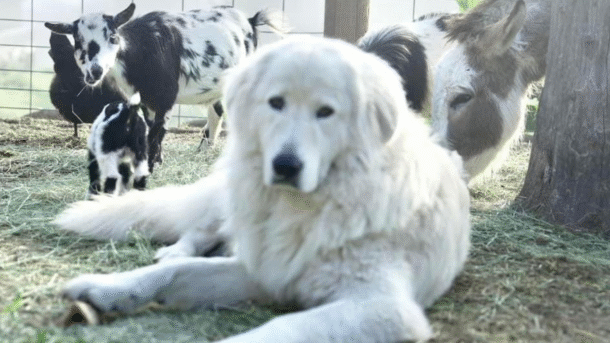
Hudson and Ripley are littermates I placed with a family on a five-acre homestead in Washington about a year and a half ago. They guard goats, ducks, and chickens, and they’re gentle with the kids. When a new neighbor moved in nearby, the complaints started. First came the sheriff, then an anonymous letter, then a formal violation notice with a hearing.
Mary and Dan were shaken. Nobody wants to be told their dog is a nuisance for doing the job it was bred to do. They didn’t know where to turn, so they reached out to me.
Here’s what I did, and it’s what I do for every family I place my Maremma puppies with:
- I pointed them to the Farm-to-Consumer Legal Defense Fund. Most people don’t know this organization exists until they’re already in trouble. I told Mary and Dan about it, and it was just the resource they needed.
- I walked them through the basics. I told them to document everything, reach out to FTCLDF immediately, and that they probably do qualify under right-to-farm laws even though they're not a commercial operation. I reminded them to never punish or suppress the barking.
- I pointed out the fallacy in the neighbor's complaint. The neighbor claimed the dogs barked "all day and night". I told them the night part might be true, but the daytime barking was an exaggeration since LGDs generally sleep a lot of the day and bark very little. Why? Because predators aren't usually active in the daytime.
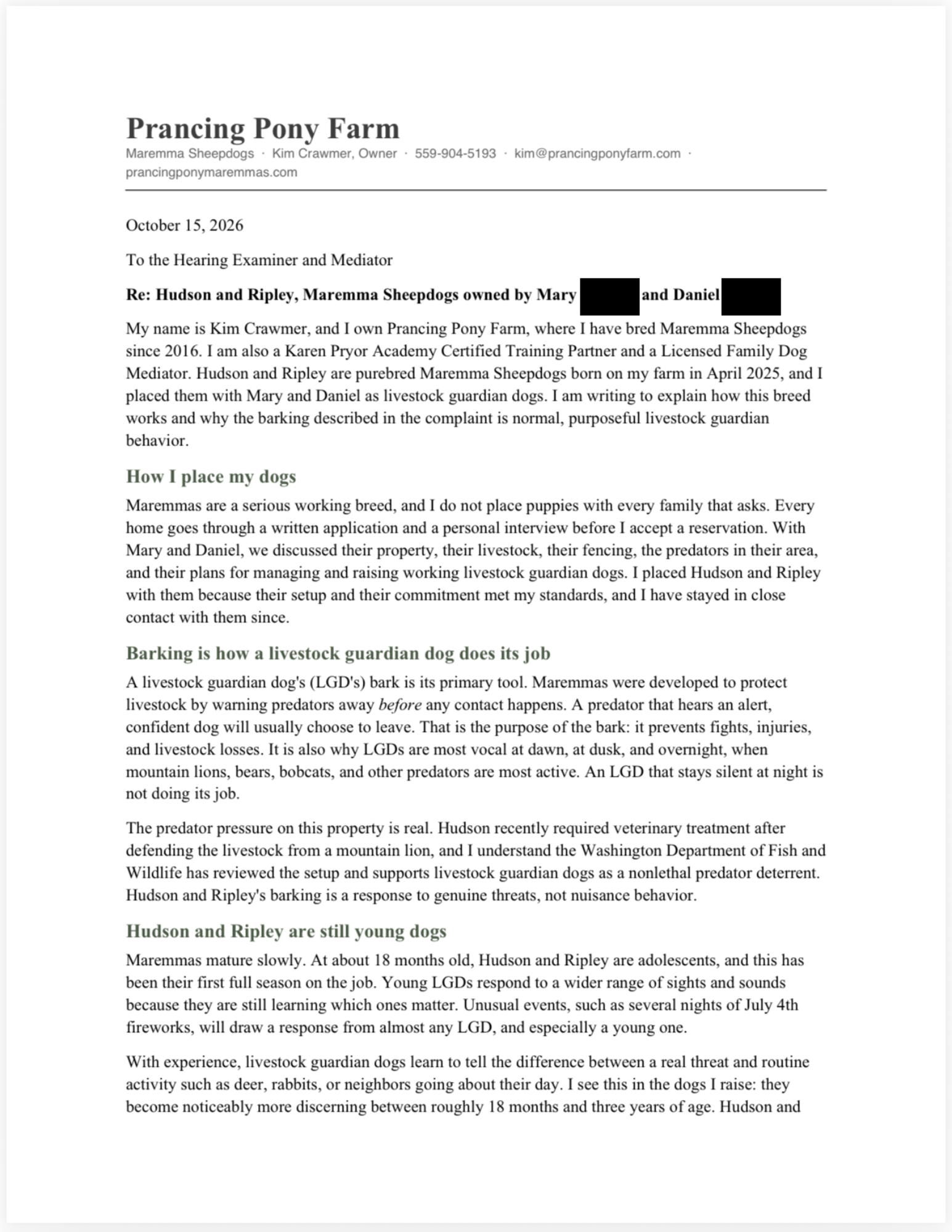
- I wrote a letter for their hearing. Their file needed an expert explanation of how livestock guardian dogs behave, so I wrote one as their breeder, a Karen Pryor Academy Certified Training Partner and a Licensed Family Dog Mediator. It’s below, with identifying details removed.
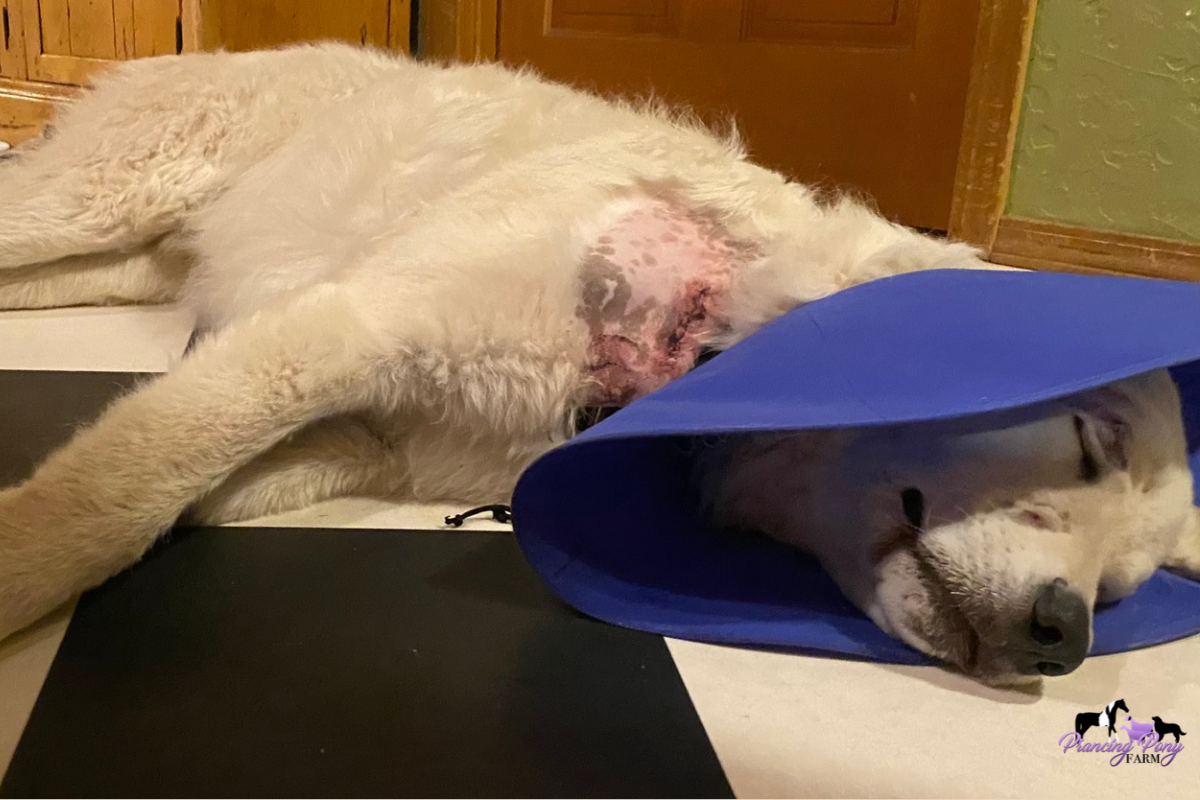
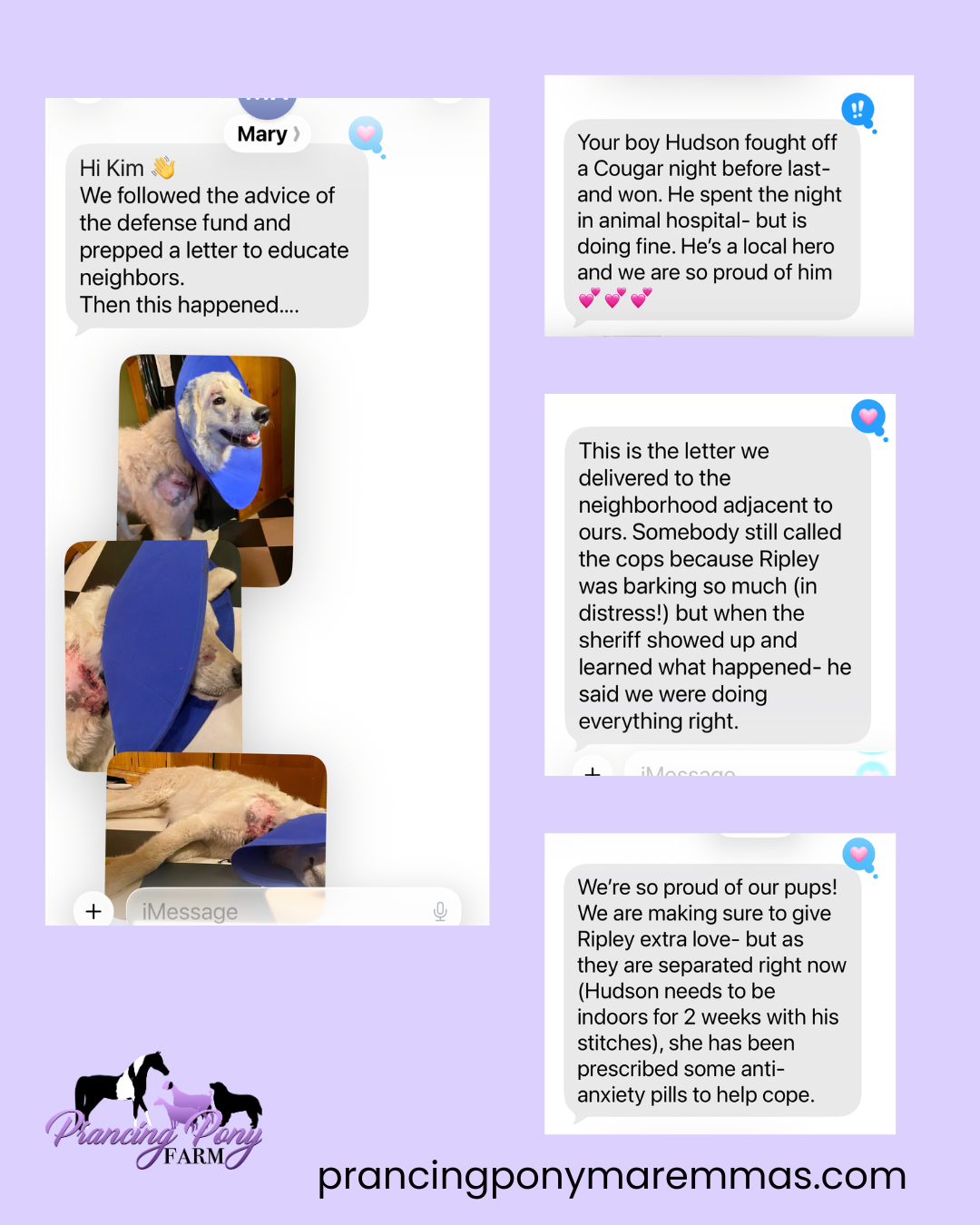
Then a mountain lion jumped their fence, and Hudson ended up in emergency surgery. Read Hudson’s full story here. That night turned the barking complaint into documented proof that the predator threat was real.
What to Do If a Neighbor Complains About Your Maremma Sheepdog's Barking
- Check your zoning. Confirm your property is zoned agricultural or rural residential, and look up your state's specific right-to-farm statute.
- Document everything. Keep any complaint letters, texts, or notes from sheriff visits. If the complaint is exaggerated (claiming barking "all day" when your dog is quiet during daylight, for example), that inconsistency matters.
- Don't suppress the barking. A bark collar or constant correction teaches a livestock guardian dog not to warn you — which defeats the entire purpose of having one. (More on this below.)
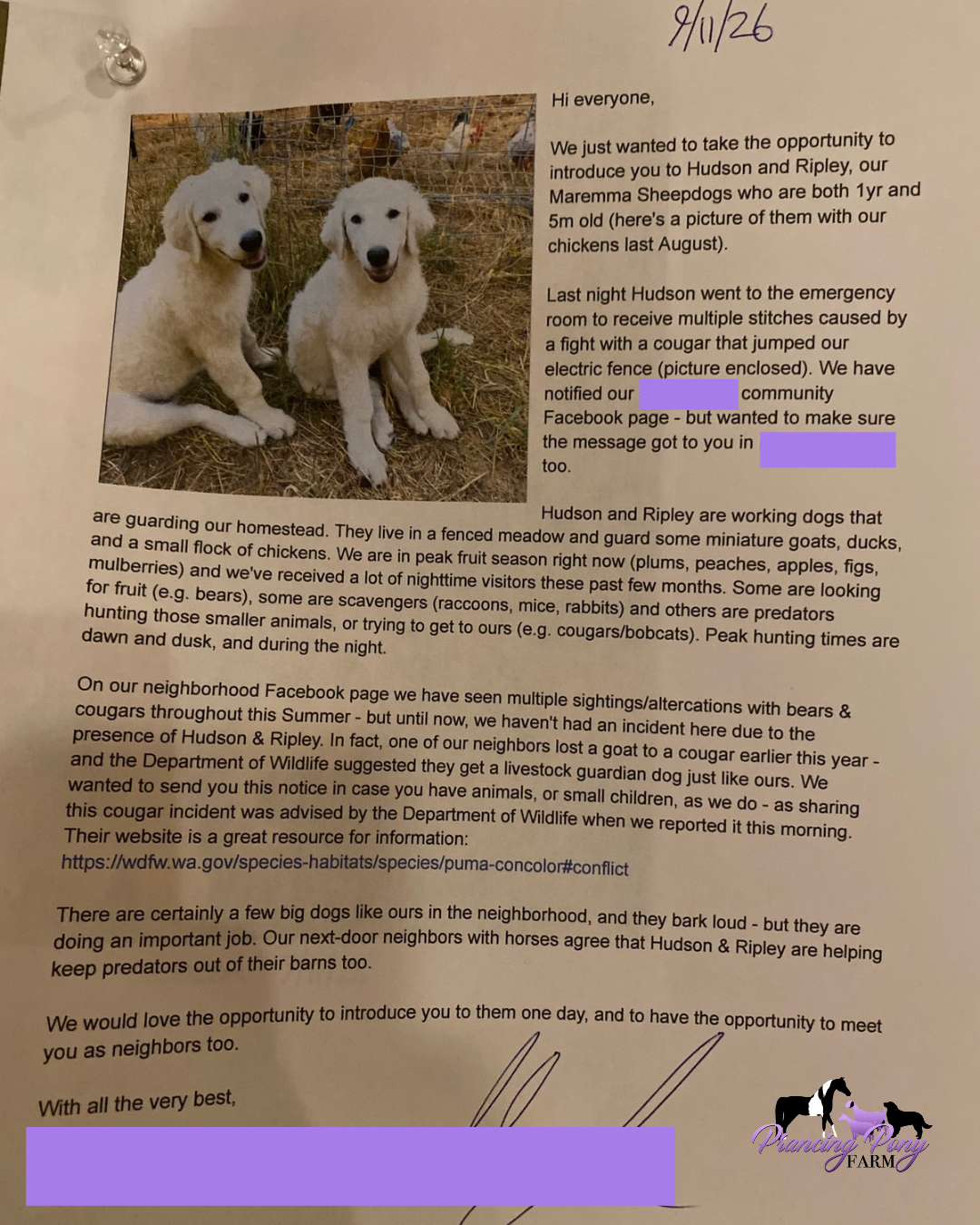
- Write an educational letter. Introduce your dogs to the neighborhood, explain their job, and invite people to meet them. Most people soften considerably once they understand a dog isn't barking at nothing.
- Post in your neighborhood group. A little proactive transparency goes a long way toward heading off assumptions.
- Get expert backup if it escalates. The Farm-to-Consumer Legal Defense Fund has a livestock guardian dog division specifically for situations like this.
- Ask your state wildlife agency to inspect your setup. After the attack, Mary asked a state wildlife conflict specialist to look at their property. He put in writing that the agency recognizes livestock guardian dogs as legitimate nonlethal predator control, and he praised their electric fencing, secure night shelters, and dogs. A letter like that is hard for anyone to dismiss.
- Gather other helpful records. Mary also gathered a vet record from the attack, property records showing livestock had been kept there before the neighboring subdivision existed, and a letter to her neighbors. Her file was thorough, and every piece of it helped.
Why You Shouldn't Punish a Livestock Guardian Dog for Barking
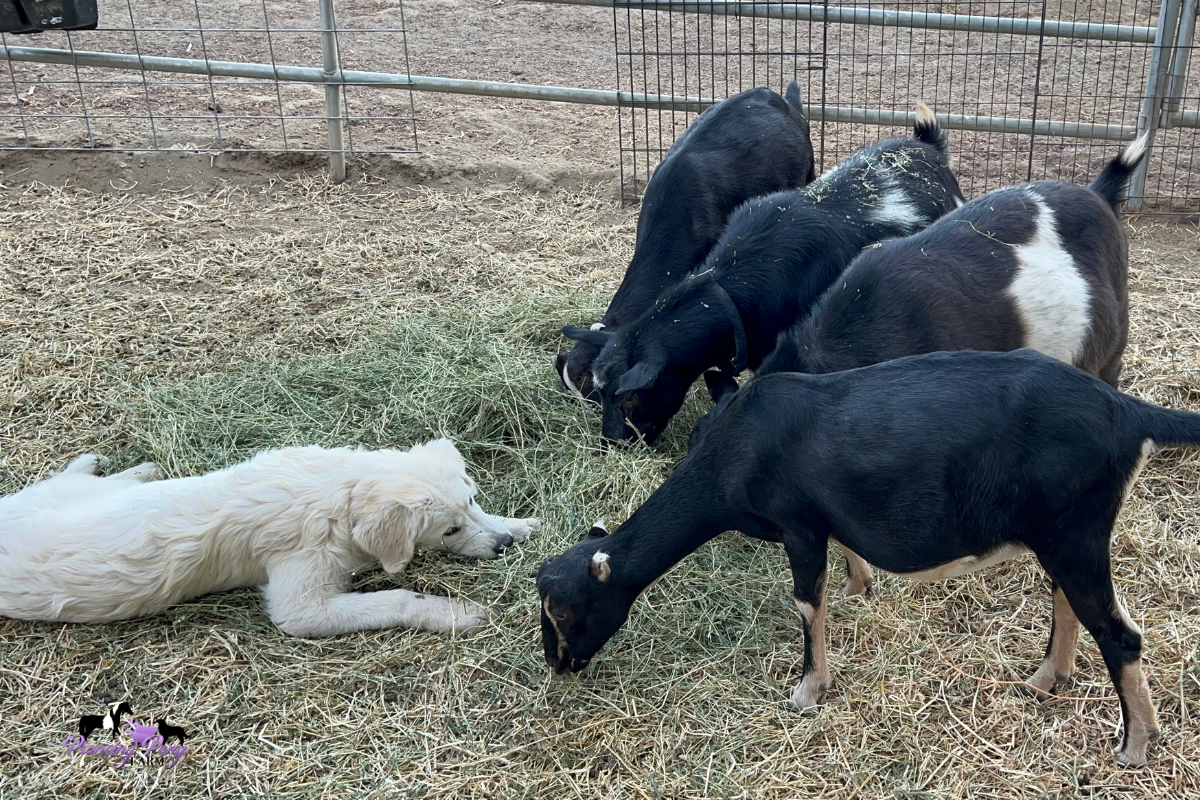
Barking is a livestock guardian dog's first and most important defense. It's how they warn predators off before a confrontation is ever necessary. Most predator encounters end right there — the predator hears the warning and moves on. Punishing or suppressing that instinct doesn't just make for an unhappy dog; it removes the safest layer of protection your animals have.
Where to Get Help: The Farm-to-Consumer Legal Defense Fund
This is the organization I sent Hudson and Ripley’s family to. Without that nudge, they might never have found it. That's what I'm here for.
If a complaint moves past "annoying" and into "sheriff visits" or "anonymous letters," the Farm-to-Consumer Legal Defense Fund is worth joining. It's membership-based, similar in spirit to organizations like the Homeschool Legal Defense Fund — you join, and if you need help, they're already familiar with your situation and ready to advocate. They handle zoning disputes, raw milk sales, farm product regulations, and yes, livestock guardian dog noise complaints.
The Letter I Wrote to Help My Clients Defend Their Livestock Guardian Dogs
I want you to see exactly what this support looks like. Here’s the letter I wrote for the hearing, with names and locations removed. If a neighbor ever challenges your dog’s bark, you’re welcome to use it as a model and ask your own breeder or trainer to write one for you.
Prancing Pony Farm
Maremma Sheepdogs · Kim Crawmer, OwnerTo the Hearing Examiner and Mediator
Re: Hudson and Ripley, Maremma Sheepdogs owned by two of my clients
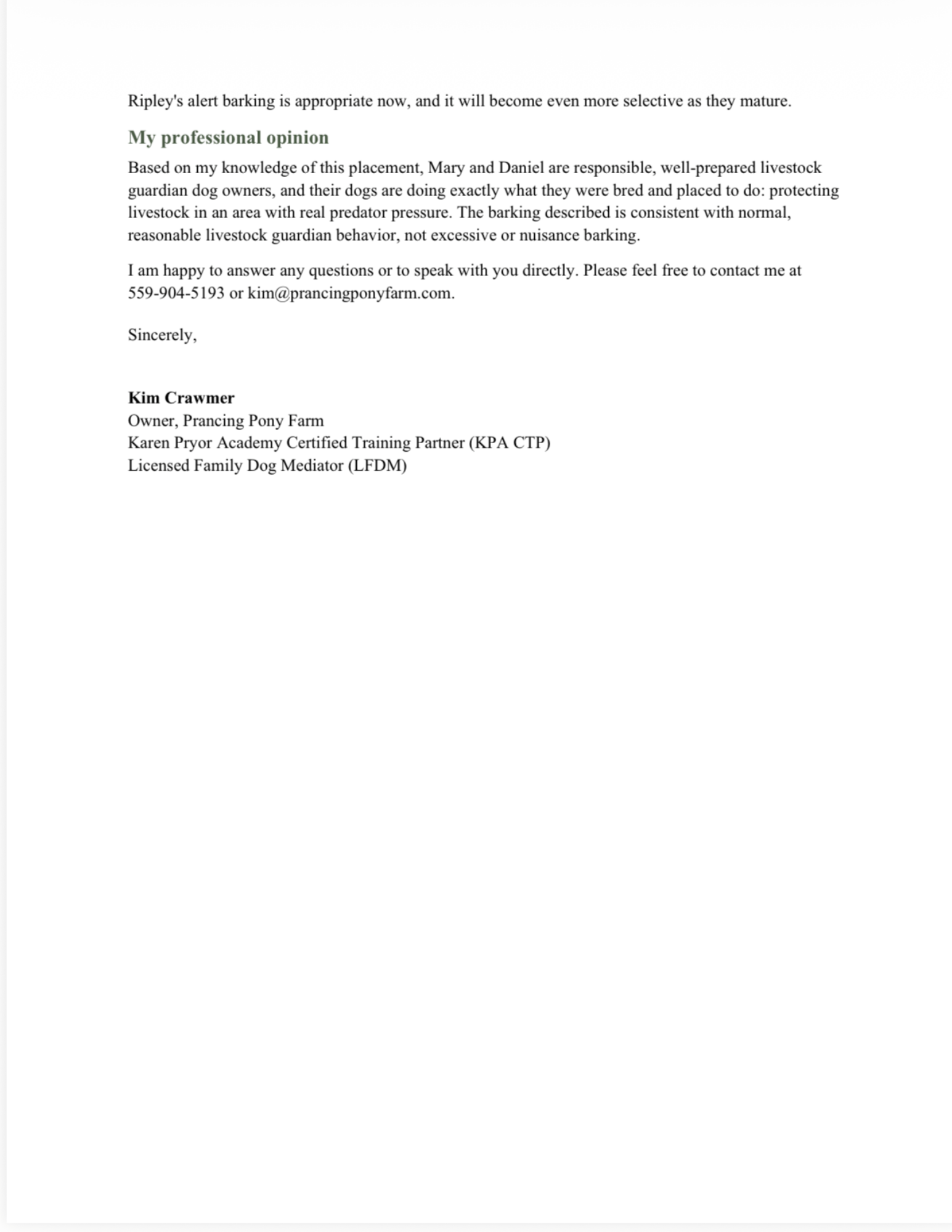
My name is Kim Crawmer, and I own Prancing Pony Farm, where I have bred Maremma Sheepdogs since 2016. I am also a Karen Pryor Academy Certified Training Partner and a Licensed Family Dog Mediator. Hudson and Ripley are purebred Maremma Sheepdogs born on my farm in April 2025, and I placed them with these owners as livestock guardian dogs. I am writing to explain how this breed works and why the barking described in the complaint is normal, purposeful livestock guardian behavior.
How I place my dogs
Maremmas are a serious working breed, and I do not place puppies with every family that asks. Every home goes through a written application and a personal interview before I accept a reservation. With these owners, we discussed their property, their livestock, their fencing, the predators in their area, and their plans for managing and raising working livestock guardian dogs. I placed Hudson and Ripley with them because their setup and their commitment met my standards, and I have stayed in close contact with them since.Barking is how a livestock guardian dog does its job
A livestock guardian dog’s (LGD’s) bark is its primary tool. Maremmas were developed to protect livestock by warning predators away before any contact happens. A predator that hears an alert, confident dog will usually choose to leave. That is the purpose of the bark: it prevents fights, injuries, and livestock losses. It is also why LGDs are most vocal at dawn, at dusk, and overnight, when mountain lions, bears, bobcats, and other predators are most active. An LGD that stays silent at night is not doing its job.The predator pressure on this property is real. Hudson recently required veterinary treatment after defending the livestock from a mountain lion, and I understand the Washington Department of Fish and Wildlife has reviewed the setup and supports livestock guardian dogs as a nonlethal predator deterrent. Hudson and Ripley’s barking is a response to genuine threats, not nuisance behavior.
Hudson and Ripley are still young dogs
Maremmas mature slowly. At about 18 months old, Hudson and Ripley are adolescents, and this has been their first full season on the job. Young LGDs respond to a wider range of sights and sounds because they are still learning which ones matter. Unusual events, such as several nights of July 4th fireworks, will draw a response from almost any LGD, and especially a young one.With experience, livestock guardian dogs learn to tell the difference between a real threat and routine activity such as deer, rabbits, or neighbors going about their day. I see this in the dogs I raise: they become noticeably more discerning between roughly 18 months and three years of age. Hudson and Ripley’s alert barking is appropriate now, and it will become even more selective as they mature.
My professional opinion
Based on my knowledge of this placement, these owners are responsible, well-prepared livestock guardian dog owners, and their dogs are doing exactly what they were bred and placed to do: protecting livestock in an area with real predator pressure. The barking described is consistent with normal, reasonable livestock guardian behavior, not excessive or nuisance barking.I am happy to answer any questions or to speak with you directly.
Sincerely,
Kim Crawmer
Owner, Prancing Pony Farm
Karen Pryor Academy Certified Training Partner (KPA CTP)
Licensed Family Dog Mediator (LFDM)
What Breeder Support Should Look Like for a Maremma Sheepdog Owner
When you’re choosing a breeder, ask what happens after you take your puppy home. Will they answer the phone when a neighbor complains? Will they know where to send you for legal help? Will they put their name and credentials on a letter and send it to a hearing?
I do all three, because I believe placing a livestock guardian dog is the start of a relationship with the family, not the end of a sale. That’s what lifetime breeder support means to me. If you’re thinking about a Maremma Sheepdog and want a breeder who’ll still be in your corner when things get hard, apply here for one of our Maremmas.
Quick Takeaways
- Right-to-farm laws exist in every state and generally protect normal agricultural practices, including livestock guardian dogs, on properly zoned land
- These protections aren’t limited to commercial farms
- Document complaints, know your zoning, and don’t suppress your dog’s bark
- Ask your state wildlife agency to inspect your setup. A written statement that livestock guardian dogs are an accepted nonlethal predator control carries real weight.
- The Farm-to-Consumer Legal Defense Fund has a livestock guardian dog division built for exactly this situation
- A good breeder stays in your corner after the sale, with referrals and, when needed, a letter explaining livestock guardian dog behavior
Frequently Asked Questions
Is a barking dog automatically a noise ordinance violation?
Not necessarily. Most noise ordinances include exceptions for agricultural activity in rural-zoned areas. Check your specific local ordinance language.
Do right-to-farm laws apply to small hobby farms, or only commercial operations?
In most states, they apply broadly to agricultural activity on properly zoned land, regardless of farm size or commercial status.
What if my neighbor was there before my animals or dog?
This can matter depending on your state's specific statute — some protections hinge on which use was established first. It's worth researching your state's exact language or asking an organization like the Farm-to-Consumer Legal Defense Fund.
Should I get a bark collar to stop complaints?
I don't recommend it for a working livestock guardian dog. Suppressing the bark removes the dog's primary warning system and can leave your livestock more exposed, not less.