Last Updated on October 29, 2026 by Kim Crawmer, KPA CTP, LFDM
A few weeks back I told you about Hudson, the Maremma Sheepdog who fought off a mountain lion to protect his family's homestead. His story isn't rare — it's one version of something that plays out on small farms constantly. I want to share a few more and talk honestly about what predators actually are, because I think there's a lot of confusion about what livestock guardian dogs protect against, and why that protection matters.
A Coyote Named Wendy
Around the same time Hudson was recovering, a video was making the rounds online about a coyote in Southern California that people had nicknamed Wendy. She'd been living with a visibly severe facial injury for over a year before a rescue group finally caught her. At the vet, they discovered she'd been shot in the face — twice — and the damage was too extensive to treat. She was humanely euthanized.
It's a genuinely sad story, and it's understandable that people felt for her. Nobody wants to see an animal suffer. But the online reaction also revealed something worth talking about: a real disconnect between how people picture predators and what predators actually do in the wild, especially in areas where human development has pushed them into closer contact with farms, pets, and livestock.
Predators Aren't Villains — But They Are Predators
A coyote, a mountain lion, a bobcat — these are wild animals doing what wild animals do. That's not evil, and it's not something to hate them for. But it also means that a coyote living near farms and neighborhoods is very likely hunting small pets and livestock to survive, not out of malice, just biology. Holding both of those truths at once — that predators deserve to exist, and that protecting your animals from them is completely reasonable — isn't a contradiction. It's just realism.
This is exactly the gap livestock guardian dogs fill.
Real Prancing Pony Client Stories: When Maremmas Meet Mountain Lions
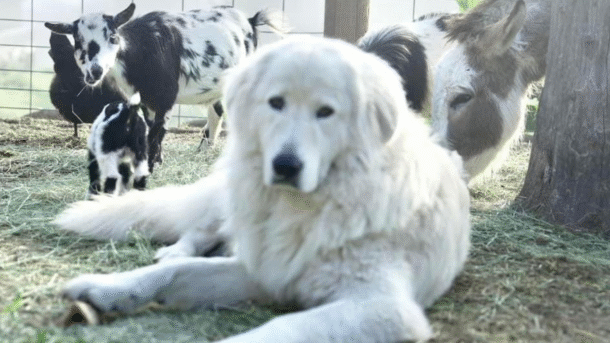
Leo, a Maremma puppy from our 2019 litter, about four or five months old, kept barking at a mountain lion attacking one of his family's goats until his owners finally came outside to check. The goat had been badly hurt, but Leo's barking — the very behavior some neighbors complain about — bought enough time to save her life.
Bocca, an adult Maremma from our October 2022 litter, was guarding a small property with goats, chickens, and a miniature donkey when he put himself between his owner and a charging mountain lion, barking and standing his ground until the cat backed off. No fight. No injuries. Just a dog doing exactly what he was bred to do.
And then there's a story with a harder ending. A client in a mountainous part of California lost a beloved miniature horse to a mountain lion one night—her Prancing Pony Maremma brothers, Arthur and Merlin, born in 2022, were stationed with the goats in another part of the property and couldn't protect the horse. They did bark, but the owners assumed it was just a fox and didn't realize the horse was being attacked until they found her the next day. It was a devastating loss, and it's a reminder that even the best livestock guardian dogs can only protect what's within their reach. It's part of why I recommend thinking carefully about where your dogs are positioned relative to every animal you're hoping to protect, and why more dogs, spread appropriately, can matter as much as good dogs.
How Livestock Guardian Dogs Allow Coexistence
Here's what I want people to understand: in the vast majority of encounters, a livestock guardian dog doesn't have to fight anything. Barking alone does the job. It tells a predator, loudly and clearly, that this property is too much trouble to bother with. The predator moves on to find easier, undefended territory — and it lives to hunt somewhere else.
That's the quiet miracle of livestock guardian dogs: most nights, nothing happens. Not because there's no predator nearby, but because the predator heard the warning and left. Hudson's night was the rare exception where a warning wasn't enough. Leo's and Bocca's stories are much more typical.
That is also why I believe more pet owners—not just livestock owners—could benefit from a livestock guardian dog. Coyotes take cats. They take small dogs. They attack small children. Bears and mountain lions can be very dangerous to pets and humans, even in some urban areas. If you live anywhere near places where these predators live or hunt, that risk doesn't require goats or chickens to be real for you, too.
Quick Takeaways
- Predators aren't villains, but they are predators — both things are true at once
- Livestock guardian dogs prevent the vast majority of conflicts through barking alone, before any physical encounter happens
- Physical altercations, like Hudson's, are the exception, not the rule
- Livestock guardian dogs can only protect the animals within their reach — positioning and pack size both matter
- Predator pressure is a reason to consider a livestock guardian dog even for household pets, not just livestock
Frequently Asked Questions
Do coyotes attack livestock or pets during the day?
It's uncommon but not impossible, especially if a coyote is desperate or has grown unusually bold around humans. Most activity happens at dawn, dusk, and night.
Can livestock guardian dogs and predators coexist without violence?
Yes — in most cases, barking alone is enough to send a predator elsewhere without any physical confrontation.
Are mountain lions a threat to small pets or children?
Yes, more so than coyotes. Mountain lions are capable of preying on animals much larger than a house cat or small dog, and there are unfortunately documented cases of attacks on people, particularly children, in areas with high mountain lion activity.
Why did the livestock guardian dogs in the horse-loss story not respond in time?
Livestock guardian dogs can only protect what's within their immediate territory. If animals are spread across a large property or in a separate area, dogs stationed elsewhere may not be able to reach them — which is why positioning and having enough dogs for your layout matters.