Last Updated on May 9, 2026 by Kim Crawmer, KPA CTP, LFDM
YOUR MAREMMA MATCH:
A Pair of Adolescent Maremmas
Past the hardest puppy phase. Still young enough to make your farm their home. The sweet spot between starting from scratch and proven experience.
Why Adolescents Are Right for Your Situation
You want livestock protection without waiting the full 24 months that puppies require to reach maturity. But you also want dogs who are young enough to truly bond with your livestock and adapt to your farm — not fully mature adults who are already set in their ways.
Adolescent Maremmas give you that exact middle ground. And it's not a compromise — it's a genuine advantage.
What "Adolescent" Actually Means
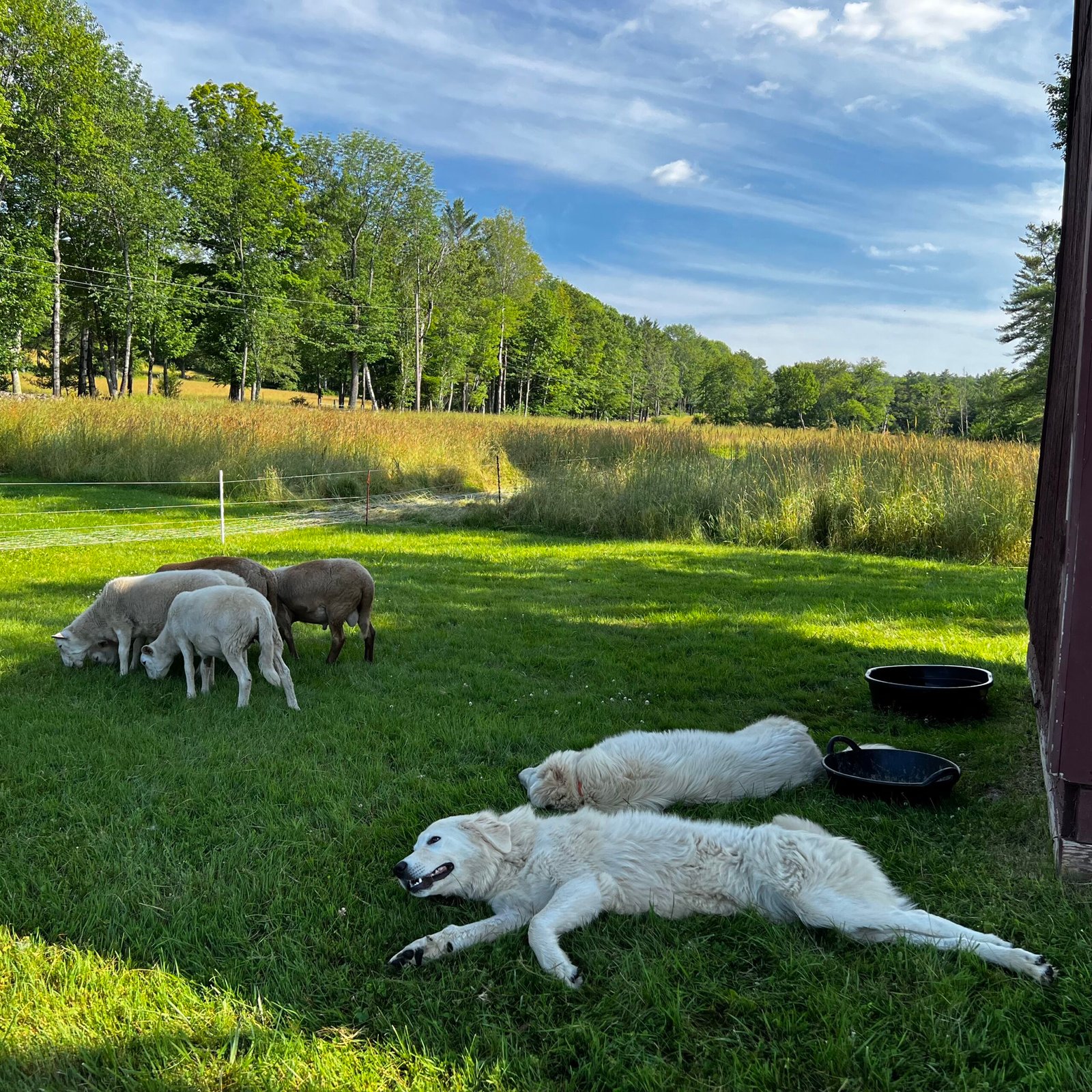
An adolescent Maremma is roughly 6 to 24 months old, depending on the individual. They're past the most intensive puppy phase but haven't reached full maturity. Think of them as LGDs who've graduated from elementary school — they understand the basics of their guardian role, they've been socialized with livestock, and they have real physical presence and size. But they're still growing, still developing judgment, and still forming the deep bonds that will define their working lives.

What They Bring to Your Farm
- Livestock socialization from birth — they know what livestock are and how to behave around them
- Significant physical size and presence — real deterrent value against predators from day one
- Basic understanding of their livestock guardian dog role
- Foundation of positive human socialization — they won't be afraid of you or your family
- Past the most demanding puppy phase — no midnight potty runs, no mouthing everything in sight
- Emerging livestock guardian instincts and developing protective behaviors
What They're Still Developing
- Complete impulse control — they'll still test boundaries occasionally
- Consistent judgment in all situations — expect the occasional questionable decision
- Full physical maturity (continues until 2-3 years of age)
- Deep, reliable guardian behaviors — the truly consistent stuff comes with time and experience
- Complete bonding with YOUR specific livestock — that happens after they arrive at your farm

A Note If You Have Companion Dogs at Home
If you have pet dogs — especially small breeds — and you want your Maremma to coexist peacefully with them, this is an important factor in choosing the right age. Younger adolescents (8-9 months) have sometimes integrated well with existing companion dogs, depending on temperament and socialization history. But it's not guaranteed. The older the dog, the less likely a smooth integration becomes.
If companion dog compatibility is a priority, a puppy may actually be the safer choice for your situation — even if everything else points to an adolescent. This is something I will want to discuss with you during your discovery call. Be sure to mention your companion dogs when you fill out the application.
The Adolescent Advantage: Not a Compromise
You might be wondering: am I settling by going with adolescents? Should I just get puppies and do it from scratch? Or hold out for fully trained adults?
For your situation, this isn't splitting the difference. It's getting the best of both worlds.
Compared to Puppies
- You skip 6-18 months of the most intensive developmental work
- You're past the phase where most people get overwhelmed and question everything
- You have a dog with real physical presence from day one — not a 25-pound fluffball
- Your timeline to reliable working protection is significantly shorter
Compared to Adults
- They're still young and adaptable — they'll genuinely make your farm their home
- The transition is typically smoother than with a mature adult deeply attached to their previous environment
- You still influence the final stages of their development
- They bond with your livestock during a critical developmental window
Adolescents are adaptable in ways adults aren't, and proven in ways puppies aren't.

What to Realistically Expect
Adolescents aren't finished products. They're partway through a journey, and they're ready to complete it on your farm. Here's what the timeline typically looks like:
The Transition (Weeks 1-3)
Your new dogs are adjusting to a completely new environment. They may seem cautious, unsure, or reserved at first. This is normal. Give them a secure space, introduce livestock gradually, and let them set the pace. Having two bonded dogs together makes this dramatically easier — they anchor each other through the change.
Settling In (Weeks 3-8)
Their personalities emerge on your farm. They're figuring out the layout, the livestock, the routines. Livestock guardian behaviors that were developing before placement start appearing in your context — positioned near livestock, alerting to activity on the perimeter, choosing to spend time with the animals.
Continued Development (Months 2-18)
Depending on the individual dog's age at placement, you may have 6-18 months of ongoing maturation. Impulse control gets more consistent. Judgment deepens. The dogs become tuned to YOUR property's specific rhythms and threats. This is the phase where they go from "promising" to "reliable."
Every adolescent we place comes with my personal support through this entire process. Transition plan, integration guidance, troubleshooting — whatever you need, for the life of your dogs.
Why Two Adolescents, Not One
After placing over 150 Maremmas, the pattern is undeniable: single working LGDs struggle. They develop loneliness, stress, and behavior problems — excessive barking, chasing livestock, escaping, anxiety — that have nothing to do with training and everything to do with being a social pack animal living in isolation. Livestock can't meet a dog's social needs. Another dog can.
With adolescents specifically, this matters even more. An adolescent leaving the only home they've ever known and arriving at a strange farm is going through a major life change. Having a familiar companion through that transition makes an enormous difference in how quickly they settle, how confident they feel, and how smoothly they integrate with your livestock.
A pair of adolescents who already know each other support each other through the adjustment in ways a single dog can't. They play together instead of taking boredom out on your livestock. They share the workload. They provide backup protection. One dog alone is one point of failure for your entire operation.
About Availability
Honest truth: we don't always have adolescents available. Our program isn't set up to produce a conveyor belt of started dogs. Adolescent availability depends on what's happening in our breeding and placement program at any given time.
Sometimes we have:
- Young dogs we've held back for evaluation in our breeding program
- Dogs transitioning between roles
- Puppies from recent litters reaching the adolescent stage
- Dogs that aren't publicly listed on our website but are available for the right home
That last point is important. Not every available dog appears on our website. Some dogs — including adolescents — are discussed in personal conversations rather than public listings, because the right match depends on details that are better explored one-on-one.
The best way to find out what's available is to fill out our application and book a discovery call. Even if we don't have the right adolescents today, we can often give you a realistic timeline.
Your Investment
Adolescent Maremmas start at $3,500 and may be priced higher depending on the individual dog's age, training level, and development.
Every adolescent includes:
- Health-tested genetics from our breeding program
- Professional socialization foundation from birth
- Complete health and vaccination records
- Personalized transition and integration plan
- Lifetime breeder and trainer support from Kim
Keep in Mind
This recommendation is a starting point, not the final word. Adolescents hit a sweet spot for a lot of people, but your situation might be better served by starting with puppies (if you have more time than you think and love the idea of raising them from scratch) or going straight to experienced adults (if your need is more urgent than your answers suggested). Seven questions can only tell us so much.
If you're reading this and thinking a different age feels right — or if you're genuinely unsure — let's talk about it. That's what our discovery call is for. We'd rather help you land on the right answer than have you second-guess a quiz.
The Master Reservation List Advantage
Adults and older adolescents from our program are rare. We don't mass-produce started dogs. When they become available, it's usually because of a specific circumstance — a dog transitioning out of our breeding program, a placement that creates an unexpected opportunity, a dog whose development path opened the perfect match for a specific family.
The families who get first access to these dogs are the ones who've already started the conversation by being on our Master Reservation List.
How the Master Reservation List works:
A $500 reservation fee holds your place on our list. You're not committing to a specific dog — you're committing to being part of the conversation. Here's what that gets you:
- First access when adult or older adolescent dogs become available — before they're listed publicly, sometimes before I've even decided to place them
- A relationship with me where I understand your situation well enough to recognize the right match when I see it
- The reservation fee applied toward your final purchase — it's not an extra cost, it's an advance on your investment
- No pressure and no expiration — if the right dogs don't become available for six months or a year, your reservation holds
Some of our best placements have gone to families who reserved months before the right dog appeared. They weren't in a rush. They just made sure they'd be first in line when the timing was right.
Payton did exactly this. She needed two dogs, knew her timeline was flexible, and reserved two spots months before she actually needed them. When a mother-daughter pair became available — including a breeding dog I had recently decided to retire— she got the first call. By the time anyone else knew those dogs were available, she had already said yes.
Noelle reserved two older and TBD dogs months before she needed them. She eventually brought home Romeo and Pele, a one-year old brother and sister pair that was absolutely perfect for her new farm. Read Noelle's story below.
That’s what being on the Master Reservation List looks like in practice.
Important things to know before you decide:
There’s no timeline guarantee. I genuinely cannot predict when the right dog will become available — it could be weeks or many months. This works well for people with flexibility. It doesn’t work well for people with a hard deadline.
The narrower your requirements, the longer the wait tends to be. If you’re open on age, gender, and working history, your chances of a good match improve significantly.
If a dog is offered to you and you pass, the offer goes to the next person immediately. Your reservation holds your place in line, not access to any specific dog indefinitely.
The reservation fee is non-refundable, but it can be transferred to a puppy reservation if you decide to go that route instead.
If your timeline is flexible and you’re serious about getting the right dog rather than just any dog, the Master Reservation List is the smartest move you can make today.
Read Noelle's Story
Why Families Choose Prancing Pony Farm
- MSCA Code of Ethics Breeder
- Karen Pryor Academy Certified Training Partner (KPA CTP)
- Licensed Family Dog Mediator (LEGS Applied Ethology)
- Over 200 Maremmas placed in working and companion homes
- Health-tested breeding program with two-year guarantee
- Lifetime breeder and trainer support included with every dog


Why Choose Maremmas?
Not all livestock guardian dog breeds are created equal. Discover why Maremmas are perfect for busy homestead families—and why our dogs are exceptional.
How it Works
Wondering what it’s like to work with a breeder who is also a certified professional trainer? Learn about our processes and how we guide you every step of the way before and after the sale.
Available Maremmas
Ready for a puppy? In need of an older Maremma? Or planning ahead for the future? Click the link below to see our available pups and dogs and upcoming litters.
Ready to Take the Next Step?
Your next step is a free consultation call, booked right through our application form. Bring all your questions — that's exactly what the call is for, and there's no commitment required.
Not ready yet? No pressure. You’re on our email list now, and you’ll receive helpful information over the next week, plus our weekly Thursday newsletter. When the timing is right, we’ll be here.

Why Ethical Maremma Sheepdog Breeding Matters Despite Challenges
“I hate your business,” my husband tells me whenever challenges arise in my Maremma breeding program. Despite the financial strain, sleepless nights, and endless responsibility, here’s why I continue this work—and what it means for the families who trust me with their livestock’s protection.
Why Smart Planning Makes All the Difference: Your Guide to Maremma Success
The families who get perfect livestock guardian dogs all share one secret: they don’t wait until they desperately need a dog to start looking. Discover why the best Maremma placements happen months before the dogs go home, and how smart planning turns livestock protection dreams into reality.
Last Chance: Why You Need to Reserve Your Maremma Sheepdog This Week
One urgent call changed everything: “My livestock guardian dog died suddenly yesterday—now I have nothing protecting my herd from coyotes.” This farmer’s nightmare could have been avoided with one simple step, and it’s the same mistake that costs livestock owners thousands every year.
Reviews From Our Amazing Clients


































I appreciated that she also took the time to vet us to make sure the animals were going to a good home. She was not looking to unload them. She even requires we sign a contract that we get certified in positive reinforcement training and follow guidelines for their healthcare.
A little while after the puppies were born, she let us know that a few from one litter had umbilical hernias (harmless and not uncommon when a mother licks the umbilical cord excessively). She gave us the option to purchase the pup or wait for another litter. She was completely transparent in the entire process. As expected, there is no problem with the hernia.
I am seeing reviews on here from people who have never even communicated with her or purchased from her, so just a reminder to be discerning when reading reviews.

1. Health testing for the parents.
2. Parents are on site and proven LGDs.
3. Early socialization for puppies with livestock, adults, and kids.
4. Proper veterinary care for parents and puppies.
5. Careful selection of parents for genetic diversity, guarding ability, health, and confirmation.
6. Tons of support during the puppy buying process and afterwards. Kim is always responsive and takes time to help me through any issues I've encountered with our pups, offering advice and support.
We love our dogs that came from Prancing Pony Farm. They were among the first members of the family to join the farm, because we knew the importance of having well-bred LGDs to protect our stock. We have not had a single issue with predators on our farm, and we live in an area with coyotes, bears, foxes, wolves, hawks, etc, etc. They guard sheep, pigs, chickens, guinea fowl, and ducks.
I'd be remiss without acknowledging the dispute between PPF and Gold Shaw Farms, so I will just say, my husband and I always enjoyed Morgan's content, but we were really disappointed with how he's portrayed Abby and Kim. Our two girls came from the same litter as Abby. They are energetic, happy, and healthy puppies. They require training and patience. What we have experienced with them is not out of the realm of what we were expecting when we got two puppies. I think Morgan's judgement of Abby is based on his experience with Toby and has been unfair to Abby and his judgement of Kim has been inflammatory and uncalled for.
I suspect most people who are looking for a LGD already have experience purchasing dogs and stock, so know what to look for in a reputable breeder. That said, if this is your first time or your first LDG, consider what's most important to you and do your own research. You can't go wrong with someone who ticks all of those boxes and offers support to her buyers.



Even though I am new to goats and LGD, Kim the owner, has really dedicated her time to teaching me about how to raise them. She is always available to answer my questions and provides me with the expertise knowledge. I am sure she is like that with all of her clients, always willing to help.
I bought 2 Maremma LGDs and 18 goats. Yes 18 goats! I go to bed at night knowing my LGDs are protecting themselves and my 18 precious goats.
Now, I am waiting to buy another male maremma LGD since she brought a male Maremma from a Italy. Kim is always making sure her registered LGDs, ND and Mini Nubians have the best genetics possible. I fully trust my LGDs in my fields, I bought Chloe at close to six months old, and I appreciate so much that she had additional training time. In fact, the next LGD I would buy from Kim will be arriving to my farm with additional training time as well.
Prancing Pony Farm has the best quality of LGDs and goats. I will highly recommend Prancing Pony Farm if you are looking for a diverse genetics in Maremma LGDs, Mini Nubians and Nigerian Dwarfs.
I now have a 1 month old Nigerian Dwarf, and I am still getting Kim’s help to assure my kid goat grows healthy. I am just very happy I chose Prancing Pony Farm when I did. Kim is the best out there!



Kim has a top of the line welping house complete with incubators and on call mobile veterinarian.
If you are looking for a well trained Maremma puppy, this is the place to get them. Kim goes the extra mile with early clicker training, and lots of live stock exposure from day one with her puppies.
You will see how much care goes into these amazing live stock guardian dogs, if you buy from her. They are ready to go to work right away.
Thanks Kim we love our new LGD.