Not because I’m trying to sell you something — though I will get to what’s still available before I’m done. But because this was one of those weeks that reminds me exactly why I do this work. Dogs finding their people. The right homes showing up at the right time. And I finally have a minute to tell you about it.
Ryan and Rianna Came Back
In 2020, Ryan and Rianna bought two puppies from me — from two different litters born close together. They have a 33-acre farm in California where they raise chickens and goats. The goats are on a cool “invisible fence” rotational grazing system called Nofence. The dogs figured out how to work the system completely on their own.
Delta, the male, follows the goats wherever they go. Echo, the female, decided her job was different.
When Ryan called me for a Maremma consultation, he mentioned — not quite complaining, but almost — that Echo wouldn’t go out with the goats. She stayed near the house. Near the chickens. And whenever his kids went out to hike around the property, Echo went with them. Every time. Wherever they went.
I stopped him right there.
She knows what’s most important to guard. The children.
He laughed. And then he said, yeah. That’s true.
Echo isn’t failing at her job. She’s doing a job nobody assigned her — keeping those kids safe on 33 acres while Delta handles the goats. These dogs sorted it out between themselves. Nobody told them to. They just knew.
Here’s the thing about that: Ryan and Rianna now have three kids. When they bought Echo and Delta in 2020, they had one toddler. I love that about this work — I get to watch families grow alongside their dogs.
But predator pressure on their property has increased, and with Echo committed to guarding the house, chickens and the children, Delta has been out there alone with the goats. They lost three goats. Delta needed backup.
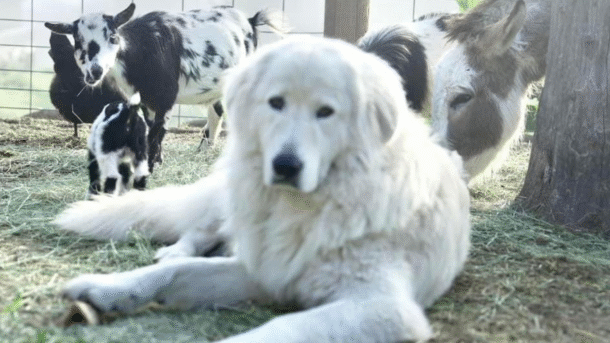
So Ryan came to pick up a five-month-old male from Electra’s November litter — the last male from that litter, as it turned out. He was here for almost two hours. We talked dogs, goats, and grazing systems. The puppy warmed up slowly, the way puppies do with new people, and then he was just doing his puppy thing, playing with the younger pups, being silly and wonderful.
Then Ryan loaded him into the backseat of his truck for the 3-hour trip home, which went great.
“He did great. Got a little carsick, but no whining and just spread out on the backseat. He did try to ride up front with me on the center console, but decided that wasn’t very comfortable.”
By the next evening, this is what Ryan sent me:
“So many friends.”
Along with a photo of the puppy sitting beside the goat fence, three baby goats pressed up against the wire on the other side, absolutely fascinated by their new housemate.
He doesn’t have a name yet — or at least Ryan hasn’t told me what it is. But he’s home. And he’s already exactly where he belongs.
Christopher Called From Connecticut
106 acres. 80 sheep. 75 ducks. 250 chickens. Lots of horses. And he raises the animals to donate to a food bank. (Not the horses!)
I want to sit with that for a second. This man is farming at scale, seriously and professionally, to feed people who need it. Stone walls for fencing. (So cool!) Good infrastructure. Employees. A real farming operation.
He wanted dogs that were two years or older, which is a preference I hear fairly often. People assume an older dog means an easier start — less puppy chaos, faster results. And sometimes that’s true. But older dogs also come with specific histories, specific needs, and very specific requirements for the right home. You can’t just plug a six-year-old dog into any situation and expect it to work. The match has to be right, sometimes even more so than with puppies.
I walked him through what I had. We talked about Diana first.
Diana is almost five years old. She came to me as a breeding candidate from a stud service arrangement under circumstances I won’t get into in detail — let’s just sayI learned a hard lesson about the fact that not every breeder socializes puppies the way I do, and why it matters. Diana arrived older than the critical socialization window, with little to no livestock exposure and she was a lot to handle. Dog-aggressive. Rough with livestock. Very slow to mature. But an absolute love-bug with humans. A biker chick in the best and worst sense of the word. She wanted to do the right thing. It just took her longer than usual to find her way.
I had her spayed before she was two. I kept working with her. I kept waiting.
And eventually — right around three years old — something shifted. She settled. She started being trustworthy with the goats. She got along with more dogs. The biker chick grew up.
Last night I was out in the pasture with her and Kazi, walking through the goats in the evening. Diana had her head tucked under my hand, walking alongside me, calm and happy and completely at ease with everything around her. I thought about all the people who passed on her over the years — too young, too old, too much history, too much money, not quite what they pictured. They don’t know what they missed.
She’s a fantastic dog. She just needed the right home.
Christopher is that home.
He also needed a second dog, since he understands the importance of working LGDs in pairs. I don’t love placing two females together as a general rule — same-sex pairs, especially females, can go sideways in ways that are hard to predict. But Kazi is the exception I feel good about. She’s about 16 months old, still young, occasionally zoomy with the goats in the way young dogs are. But she’s easygoing, deeply friendly with people, and she and Diana are genuinely bonded. They’ve been living together, along with three six-month-old females, and all of them have been getting along beautifully.
Kazi came from Gianna’s last litter — a litter I almost lost entirely. Ten puppies, and I kept finding them gone. Healthy one day, gone the next. I never figured out what happened. Two survived. Kazi was one of them. She’s been a joy from the start — the kind of dog who has personality in every photo, every interaction, every moment. (Kazi and her sister, Lia, are the young puppies in the orchard photos on my website)
She and Diana are going to Connecticut to work 106 acres of sheep and help fill a food bank.
I couldn’t have chosen a better home for either of them.
Diana in back, beside Leo, my Arabian gelding, Kazi center, and Parma’s 3 pups
Emma is in Oregon, and she’s going to be Great
Emma has 14 acres, 14 Nigerian Dwarf goats plus lots of babies, 40 chickens, and geese. She deals with the usual range of predators — and eagles, which is a slightly different problem than most of my clients face.
She’s never had livestock guardian dogs before.
She found me, got excited, and honestly jumped the gun a little — she paid her master reservation fee before we’d even had our phone call. I appreciate that kind of enthusiasm. We’ve been communicating by email, the call is coming, and she’s already chosen her dogs: two six-month-old females from Parma’s litter.
Again — two females, not typically my first recommendation. But these girls are mellow, easygoing, and have been part of a group of five young females who have been living together beautifully. For Emma’s situation and experience level, having two dogs who already know each other and are older and more experienced with livestock is exactly right.
What struck me about Emma is something she wrote in her application. She said she tries to give each creature living on her property the respect and care it deserves. She’s not looking for tools. She’s looking for partners.
That’s exactly the kind of home I want for my dogs.
She’s a first-time LGD owner. She said so herself — inexperienced with the breed, but willing to put in the time, willing to learn, willing to do whatever it takes. That’s not a liability. That’s actually most of my clients. I’d estimate somewhere around 85% of the people who buy from me have never had a livestock guardian dog before.
Keenan is in Oregon. 234 acres, Babydoll Southdown sheep — if you don’t know the breed, look them up, they’re absurdly cute — and a vineyard where the sheep will eventually graze between the rows. Mountain lions, bears, coyotes, foxes. He knows what he’s dealing with and he’s building his operation the right way.
He also first emailed me a while back, and then life happened. A lot of it, all at once. My email follow-up sequences kept sending him emails — and kept sending them — and I know some of you reading this have been on the receiving end of those sequences and maybe wondered why I don’t just let it go. Why do I send so many emails?
Here’s why: Keenan needed a ton of emails before one of them landed at the right moment. He wasn’t ignoring me because he wasn’t interested. He was buried. And when my system finally sent the one that said hey, I’m about to close your file — he came up for air, realized what was happening, and replied.
We had a call the next day. It was a great conversation. He was open, thoughtful, completely willing to listen to what I recommended. By that evening, he had reserved a male and female from Cameo’s litter.
For every person who gets a little tired of my follow-up emails, there’s a Keenan on the other end of the sequence who needed every single one of them. I can’t know which is which. So I keep sending.
His puppies are going to 234 acres in Oregon, to a beautiful vineyard and a sheep flock that’s just getting started. They’ll have so much space, so much work, so much purpose.
I love this job.
LGDs Succeed When Owners Make the Right Choice
Four families. Seven dogs. Ryan and Rianna adding to a team they built five years ago. Christopher taking on a pair that needed exactly his kind of home. Emma jumping in headfirst as a first-timer. Keenan finally coming up for air after life tried to get in the way.
Some of them already knew that was the right call. Some of them came in thinking they wanted one, and changed their minds after our conversations — or after reading things on my website, or from emails like this one. However they got there, they got there.
I talk a lot about why paired livestock guardian dogs outperform single dogs — for the livestock, for the dogs themselves, for the long-term success of the placement. It’s one of the things I feel most strongly about in this work. But what moved me this week wasn’t that I convinced people. It was that these families — on their own, through their own research and their own conversations with me — understood what their animals needed and made the decision that was right for the dogs. Not just the convenient decision. The right one.
That’s a $7,000 commitment for a pair of puppies. $7,500 for Diana and Kazi. That’s real money. And every one of these families looked at that number and said yes, because they understood what they were investing in.
What’s Still Available — and you Need to Move Fast
I’ll be honest: I have people in my inbox right now who have had consultations, who are close to being ready, who haven’t pulled the trigger yet. And there are not enough puppies for all of them.
Someone is going to miss out. That’s just the reality.
Two males from our March litter. These boys aren’t listed on the website yet — I haven’t had a chance to build their page — but they are available, and I’m already getting inquiries. If you want information on them, apply here.
And if the timing isn’t right for you right now — if you want to be ready when the next litter arrives — get on the reservation list. More puppies are coming but some of those are already reserved. If you’re serious about adding a livestock guardian dog this year, the time to get in line is before the litter announcement, not after.
P.S. — If you go to my website and notice some things look funny, that’s just because I’m in the middle of a theme update and everything is discombobulated. 😆 I’ll get it straightened out soon!
Ready to get in line for your Prancing Pony Farm Maremma?
For a limited time, come talk Maremmas with other Maremma owners and me — free. Have a different livestock guardian dog breed? You're welcome here too — most of what we cover applies to all LGDs.
These calls and their recordings will become part of the Maremmas Made Easy membership community soon, so signing up now gets you a free sneak peek at the membership, plus first access to founding-member pricing when it launches.
For a limited time, come talk Maremmas with other Maremma owners and me — free. Have a different livestock guardian dog breed? You're welcome here too — most of what we cover applies to all LGDs.
These calls and their recordings will become part of the Maremmas Made Easy membership community soon, so signing up now gets you a free sneak peek at the membership, plus first access to founding-member pricing when it launches.