Last Updated on March 19, 2026 by Kim Crawmer, KPA CTP, LFDM
They Watched the Chaos All Day — And Didn’t React
What This Moment Reveals About LGD Puppy Socialization
What a single afternoon on the farm reveals about the difference between a truly socialized LGD puppy and every other kind.
It was almost 5 pm, and Prancing Pony Farm had been running at full volume since sunrise.
A full landscaping crew had spent the entire day mowing every pasture on the property — strange people, diesel engines, weed whackers, equipment noise rolling across the acreage in waves. Normally, that level of sustained activity would have at least some of the animals on edge. And a few of them were. My Mini Nubian bucks in one of the adjacent pastures were definitely not thrilled about the mower. They paced and fussed near the fence the way goats do when a predator is in their space, and they haven’t decided what to make of it yet. (And no LGDs to protect them, since the Maremmas were locked in the barn while the work was being done.) Completely normal. Completely understandable.
But then I came around the corner of the perimeter road on my golf cart, rounded the bend past the goose run to the Puppy Parlor pasture, and stopped.
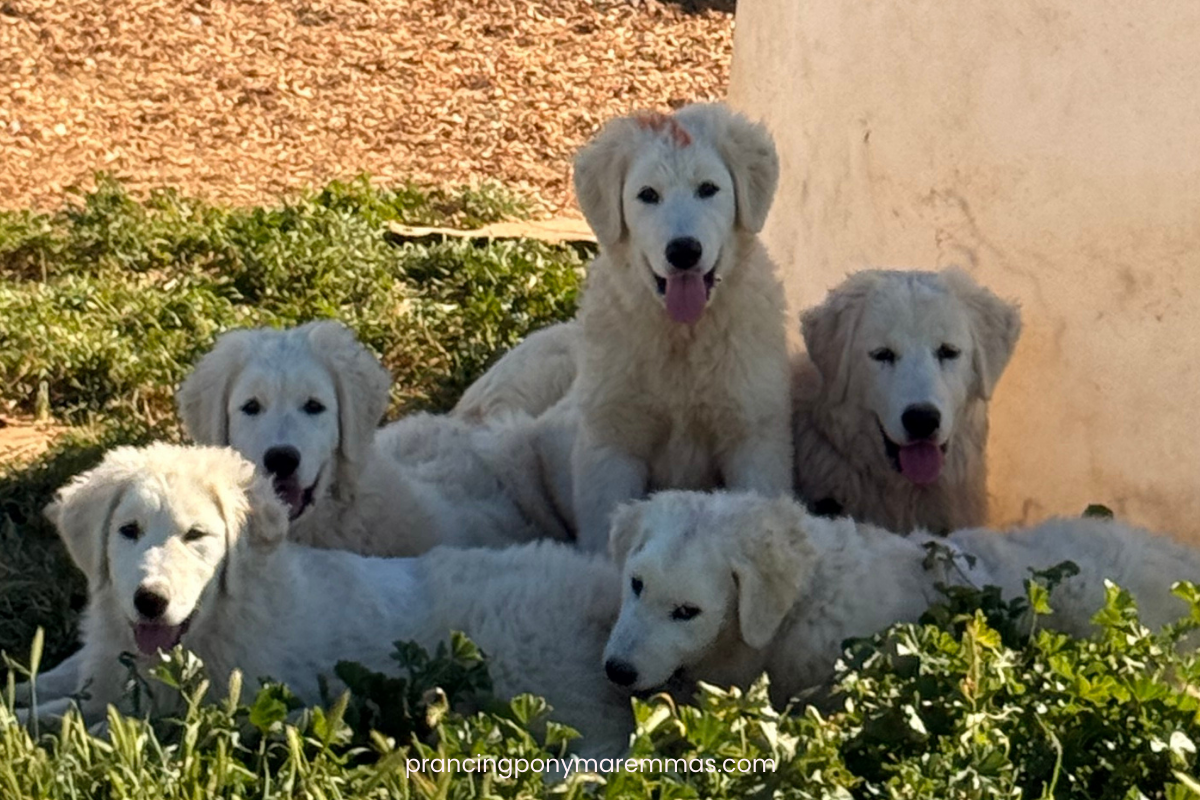
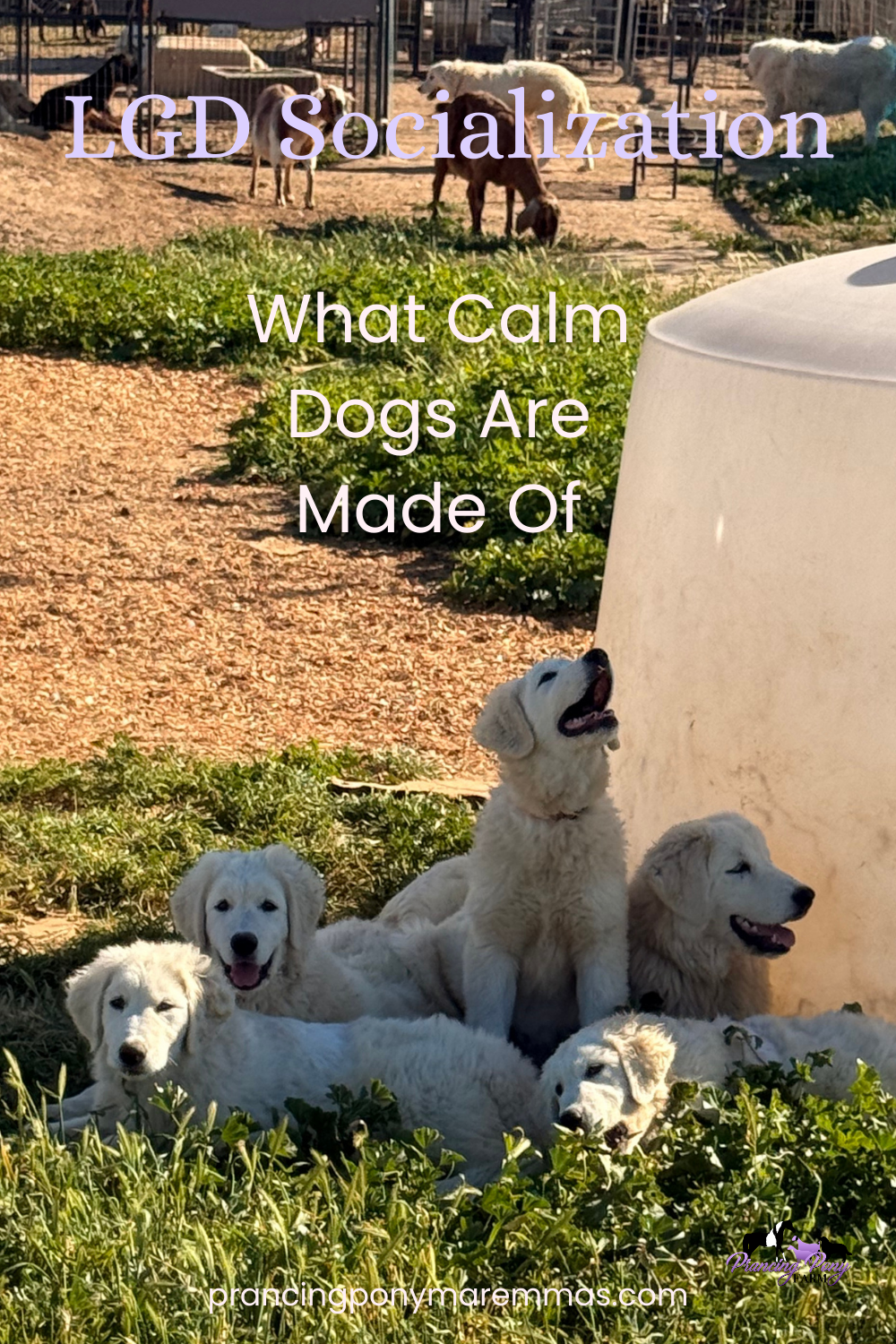
The puppies — four and five months old, around a half dozen of them — were lounging in the grass near the goats in a puppy pile. Still. Relaxed. Completely, almost insultingly unbothered by the day they’d just lived through.
And I thought: this is what we’re trying to do. What we are doing. Intentionally.
Why These LGD Puppies Stayed Calm (And Why It Matters)
Here’s the thing about that moment: the puppies weren’t calm because the noise had stopped. The noise was still going. They were calm because the noise was simply normal to them.
That’s the difference between a puppy who has been exposed to something and a puppy who has been raised inside it. The bucks in the next pasture were reacting to something unfamiliar. The puppies were sitting in the middle of their regular Saturday.
When I pulled up on the golf cart, they heard me coming, scrambled up, and rushed the fence to say hi — wiggly, enthusiastic, fully puppy. We had a little moment. They sniffed, wagged, and got their tossed treats. And then, when they’d decided they’d greeted me sufficiently, they went back to their grass and settled down again.
That behavioral sequence — notice, greet, return to calm — is exactly what you want from well-developed livestock guardian dogs. It means the dog can distinguish between a real alert and background noise. It means the dog isn’t running on ambient anxiety. It means the dog has the emotional regulation to say that’s fine, I’ll go back to what I was doing.
That’s not indifference. That’s confidence.
What “Intentional Socialization” Really Means for LGD Puppies
You’ll hear a lot of breeders use the word “socialization,” and most of them mean it genuinely. But there’s a significant difference between a puppy who has been introduced to some experiences and a puppy who has been raised in a genuinely busy, unpredictable, sensory-rich environment during the windows that actually matter.
Puppies have critical socialization periods that run roughly from weeks 3 through 16. During this window, their brains are doing something remarkable — building the template for “normal.” Whatever they encounter regularly during these weeks becomes the baseline their nervous system references for the rest of their lives. Whatever is absent from this window can be genuinely difficult to compensate for later.
This means that the question isn’t just what a puppy has been exposed to, but when, and how consistently.
At Prancing Pony Farm, our puppies don’t occasionally see farm activity — they live inside it. Every day, from the time they’re born, the Puppy Parlor pasture sits in the middle of a working farm where delivery trucks stop several times a week, clients come and go, tractors and ATVs work, grandchildren visit, the mower runs, equipment breaks down and gets fixed, and life happens. All of it, in plain view, during the exact weeks the brain is building its map of “safe and expected.”
You can’t replicate that after the fact. You can do a lot of great things with a puppy who missed this window. But you cannot go back and lay down that foundational sense of normal once the window has closed.
The Critical Socialization Window for Livestock Guardian Dogs
The Behavioral Payoff: What a Well-Socialized LGD Looks Like
What I saw that afternoon wasn’t a fluke. It was the reliable result of a deliberate process.
Puppies raised this way tend to be easier to handle, easier to introduce to new environments, and significantly more stable in the face of change. When something genuinely needs their attention — an unfamiliar animal at the fence, an actual threat to their herd — they have the bandwidth to notice it, because they’re not spending their nervous system resources on background noise that doesn’t require a response.
This matters enormously for farmers and homesteaders who want a livestock guardian dog that works with them, not one they’re constantly managing or apologizing for. A calm, confident LGD is an asset. An anxious, reactive LGD — even one with excellent genetics and good intentions — creates more problems than it solves.
The behavior sequence I watched that afternoon (rush the fence, greet warmly, settle back down) is a remarkably good indicator of what life with that dog will be like. They are friendly and engaged with the humans they know. They are calm in their environment. They are not needy, anxious, or easily knocked off their center. They check in and go back to work. That’s exactly what you’re hoping for. That’s exactly what you need.
Should You Get a Maremma Sheepdog?
Not sure if this breed is right for your farm, family, and lifestyle? Take our free 2-minute quiz and find out — before you invest thousands of dollars and years of your life.
Why Your Breeder’s Socialization Program Matters More Than You Think
Most LGD breeders fall into one of two categories: puppies raised primarily in the house with people (good human socialization, poor livestock/farm exposure), or puppies raised in a barn or pen with livestock (good livestock exposure, poor human and environmental socialization). Both produce dogs that are missing something important.
The Prancing Pony Farm Puppy Parlor was designed specifically to thread this needle — a facility where puppies live full-time with livestock from the earliest weeks, in a setting that is also embedded in a busy, multi-species, human-populated working farm. It is not an accident. It is the result of years of refining what actually works.
If you’ve ever worked with a dog that was easily startled, slow to settle after excitement, or difficult to manage around equipment and visitors, you already know that this isn’t a small thing. The foundation laid in weeks 3 through 16 shows up every single day for the life of that dog.
Started LGD Puppies: Why This Age Can Be the Best Choice
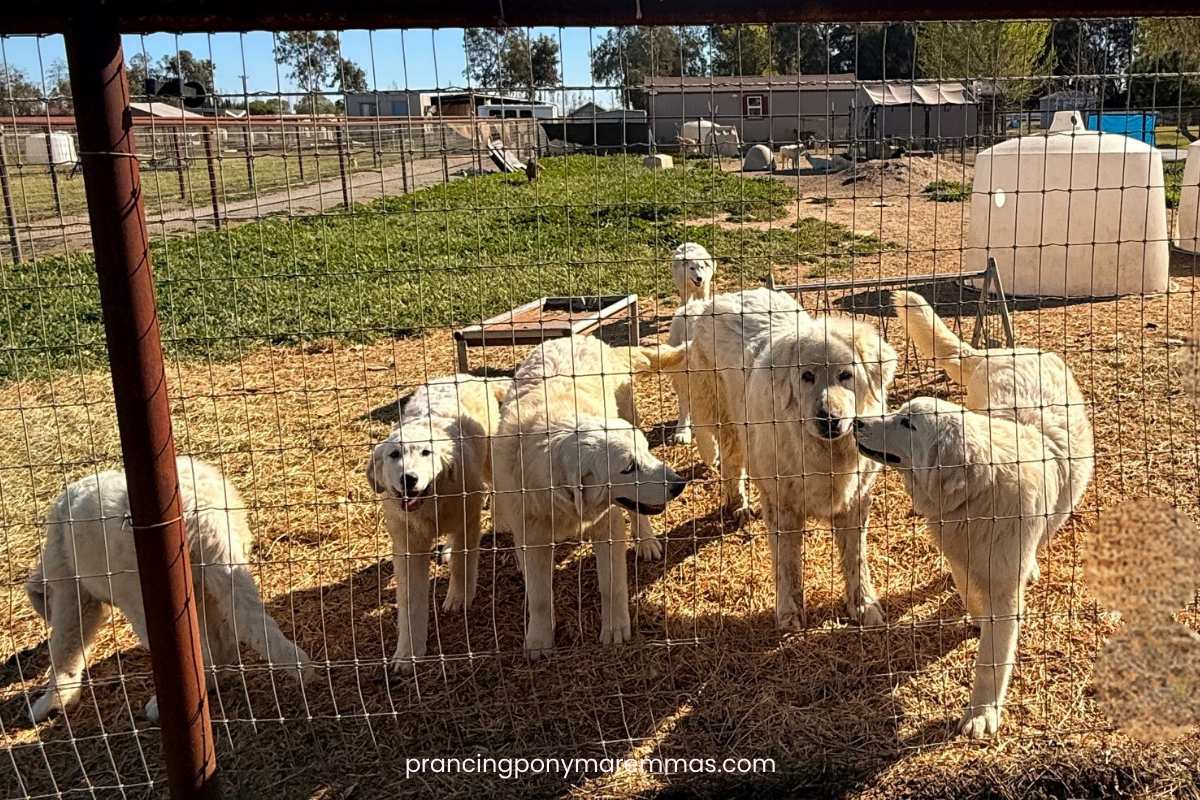
The pups you just read about — the ones lounging in the grass, unbothered by a full day of mowing — are real, and a few of them are still looking for farms and homesteads. We currently have only one boy and a couple of girls from this group available. (If you’re looking for a team, don’t miss out on this last boy since male/female pairs do best.)
There’s a meaningful advantage to a started puppy at this age that’s worth knowing: you’ve moved past the most labor-intensive early puppy stage, the temperament is established and observable (not a guess based on pedigree), and they’re ready to move into a working role significantly faster than a younger pup would be. What you see is what you get — and what you saw in this post is what you’d be getting.
If you’re evaluating breeders and want to understand more about how we raise and train our puppies from birth through placement, our full LGD Development Series walks through the entire program, week by week.
Read the LGD Development Series →
Questions about whether one of these dogs would be right for your situation? I’m happy to talk through it.
Puppy, Adolescent, or Adult — Which Maremma Is Right for You?
The age of the dog you start with matters more than most people think. Take our free 2-minute quiz for a personalized recommendation based on your experience, timeline, and situation.
FAQ: LGD Puppy Socialization
Q: What is the critical socialization window for LGD puppies?
The primary socialization window runs from approximately weeks 3 through 16. Experiences during this period become the puppy’s baseline for “normal.” What’s present becomes expected and safe; what’s absent may cause fear or reactivity later.
Q: Can a poorly socialized LGD puppy be fixed with training later?
Many things can be improved, but the neural foundation laid during early socialization is not fully replaceable. A skilled trainer can help a dog develop better coping strategies, but you’re working harder for results that proper early socialization produces naturally.
Q: Why does a "farm-raised" puppy sometimes still struggle?
Not all farm environments are equal. A puppy raised in a quiet barn pen with minimal human contact and limited sensory variety is “farm-raised” but not well-socialized. The quality and variety of early experience matter as much as the setting.
Q: What are started LGD puppies, and are they a good option?
A started puppy (typically 4–6 months old) has moved past the most intensive early development stage. Temperament is observable, livestock exposure is established, and the dog typically integrates into a working role faster than a younger puppy. For buyers who’ve done their research, a started pup can be an excellent choice.
Q: Does human socialization hurt an LGD's working ability?
No — this is one of the most persistent myths in the LGD world. Well-socialized livestock guardian dogs are more manageable, more stable, and more effective than dogs raised in isolation. A dog that trusts humans and understands its environment can focus its energy where it belongs: on the livestock.
Your Title Goes Here
Your content goes here. Edit or remove this text inline or in the module Content settings. You can also style every aspect of this content in the module Design settings and even apply custom CSS to this text in the module Advanced settings.
Your Title Goes Here
Your content goes here. Edit or remove this text inline or in the module Content settings. You can also style every aspect of this content in the module Design settings and even apply custom CSS to this text in the module Advanced settings.
Have questions or Experiences to Share?
Leave a comment below or reach out directly – I love hearing from fellow farmers and LGD owners!